If you're like most Americans, you and your children spend a lot of time on the road. There are plenty of ways for kids to pass the time on car trips, whether of 5 minutes or 500 miles. Several of them I'm quite sure you know:
Screaming "She's on MYYYY side!!!! Mom, make her get off of MYYYY side!"
Asking as often as possible, "Are we there yet?"
Threatening to throw up.
Singing vaguely risque songs like "The boys and girls are kissing in the D-R-A-K, D-R-A-K, D-R-A-K, Dark!"
Singing "George Washington Bridge." OH MY EARS QUICK RINSE THEM OUT WITH RUBBING ALCOHOL (George Washington Bridge, for those of you not in the know, repeats the lyrics "George Washington Bridge" again and again and again to an essentially unmelodic melody. My sister pulled this one on a 5-hour car ride between Chicago and La Crosse, Wisconsin, many years ago, and when she was finally told she could NO LONGER sing "George Washington Bridge" she said "Okay, then I will sing 'Adobe Bricks.' 'Adobe Bricks,' as it turns out, is 10 times worse. We eventually threw her out of the car)
But those days are over, for here is a list of WONDERFUL MATH ACTIVITIES that you can do in the car. (Assuming that your children can actually see out the windows.)
1. LICENSE PLATES. In New York State, most (not all) plates are of the form AAA 1111--three letters, then four numbers. Have kids hunt for license plates withe certain characteristics. Who can find one that has four even digits? Four odd digits? Four digits that are ascending (like 4689)? Descending (say, 8521)? Two digits that are the same? Three digits that are the same? If you're stuck at a stoplight, ask your child to add the four digits on the license plate of the vehicle in front of you--which two are best to add first? What shortcuts can your child find? (To add 6364, kids might start with 6+6=12, a "doubles fact," or with the "ten-friends" fact that 6+4=10.) Estimate by looking if the sum will be greater than or less than 20. Then check. Whoops, green light--better move on...
2. STOPLIGHTS. How many stoplights do you think there will be between here and the mall/camp/Grandma's house? Let's keep track. Will they mostly be green when we get to them, or red? You count the red ones, I'll count the green ones. Do you think it'll be about the same on the way back, or will it be different? Let's find out. For a route you drive frequently, choose a couple of lights and keep track of whether they're red or green over a period of 8-10 days. These are exercises in counting; they also ask kids to gather, use, and interpret data. More than half of the lights are green? Why do you think that might be?...That light where we cross Route 55 is almost always red when we get there--how come?
3. VROOM, VROOM. On a 4-lane highway, have kids count the cars you pass and the cars that pass you. Make this an exercise in counting forwards and backwards: start with a score of 10, add one for every car you pass, subtract one for every car that passes you. Or, start with 50 or even 100. Try not to give in to your children's pleadings to do whatever it takes to avoid being passed by that in-your-face Oldsmobile or to overtake that weirdly painted appliance truck. Does it matter who's driving?...why yes, yes, it might. (And can we correlate that with speeding tickets received? Why yes, yes, we can...)
4. NUMBERS ON SIGNS. There are lots of these running around the roads: speed limits, mileage markers, route numbers, distances to upcoming cities. We call Route 376 "route three-seventy-six," but what's its "proper" name? (Three hundred seventy-six. Yes, I know it isn't *really* a number, because it doesn't indicate three hundred seventy-six of anything...) Who can find a two-digit number on a road sign? A three-digit number? An odd number? The sign tells how many miles to Montreal and how many to Buffalo. Which is further away from us right now? How do you know?
5. MENTAL ARITHMETIC. We're at milepost 27--look, there's the sign. What milepost will we pass in five miles? Ten miles? (Careful--are we driving towards milepost 0 or away from it?) How many more miles till milepost 40? (See above.) The sign says Albany is 65 miles away. Our speed is, guess what, 65 miles per hour. About how long till we're in Albany? (Only use easy numbers for this kind of question!) The car can be a good place to go over basic facts as well: "7 + 2." "9!" "Tell me two ways to make 10." "Um--"
6. MAPS and DIRECTIONS. Have children direct you to a location they've visited many times before. Ask them to tell you where to go straight and where to turn, and whether you should go left or right when you turn. Obviously, don't break any traffic laws--you are still the captain of the ship! As for maps: Print out a map showing your route to a (relatively) nearby place. Go over the map with your child before you leave. Have your child hold the map and try to track your position along the route as you drive. Try using a road map for longer distances: Find a long thick blue line with a shield and the number 84. That's the road we're on now. We're heading west...which way is west? Can you find a city called Middletown? Excellent--we're just a little bit west of that right now. What's the next town you see? Some third and fourth graders can become quite good at navigating. Just be sure that the "road" they're having you follow isn't just a marmalade stain on the map (this happened once to Paddington Brown and his family, I believe).
As always, these are ideas, nothing more; you can come up with others yourself. Be sure not to push too hard. REPEAT: BE SURE NOT TO PUSH TOO HARD. If you find you're suddenly more invested in these activities than the kids are, cut the games short and do something else: talk, sing, tell jokes, look at scenery. But if people start yelling about siblings being on theirrrrr side, it helps to have games like find-a-license-plate-with-4-odd-digits in your back pocket; and if you can find the right combination of math activities for the car ride on any given day, you will NEVER EVER EVER have to put up with anybody singing George Washington Bridge, and that will make any hardship worthwhile.
Showing posts with label SummerMath. Show all posts
Showing posts with label SummerMath. Show all posts
Tuesday, August 4, 2009


Thursday, July 16, 2009
SummerMath, Part 3: The Bikepath, the Ballpark, and Beyond
My family went to the ballgame the other day, attracted by among other things a "Henry Hudson Bobblehead" giveaway (see picture). My son is quite eager to show off his Hudson Valley roots with this, um, iconic image when he heads west for his next college semester, and as for the rest of us, well, how could we pass up such a quality and historic freebie??
 (Ol' Henry)
Anyhow, the game put me in my mind of Sports and Math. I spent most of my childhood free time engaged in one of five activities:
1) eating
2) reading the classics, mainly the Hardy Boys books
3) writing short stories with meandering plots and lots of unnecessary characters
4) playing board games and card games (see SummerMath Parts 1 and 2)
and
5) playing, watching, reading about, or thinking about baseball.
Baseball and math are closely linked, and in fact I learned quite a lot about math from my interest in baseball. My 1972 Sports Illustrated baseball board game (see 4 and 5 above) helped inform me about probability. I can remember the power I felt when I realized that I could use what (little) I knew about ratios to compare teams' won-lost records in my head--was it better to be 38-37 or 37-36, and how could I prove it? And I developed some facility with division, if not comprehension of WHY it worked, by virtue of calculating my batting average every day back when I was ten or so. (My batting average was very good. I counted it as a hit, of course, if someone muffed a ball I'd put in play. Or if the umpire mistakenly called me out when I was CLEARLY safe at first--don't laugh, it happened all the time. Or if I hit a line drive or a deep fly ball that somebody managed to corral, but which clearly SHOULD'VE been a hit--why should I be penalized just because my opponents had good hands? That was in addition to the occasional, you know, REAL hits I got. As I said, my batting average was very good.)
In any case, there are lots of ways to combine math with sports, for those of you whose children like to watch baseball, play soccer, ride bikes, or mess around with balls and such in the back yard after dinner. Here are some ideas of questions you can ask and projects you can do:
*Counting and estimating. "I wonder how many pitches the pitcher will throw this inning. Do you think it'll be more than 15 or less than 15?" "Take ten shots on goal from right here. Let's see how many go in...Now let's move you back a few feet. How many do you think will go into the net now?" "Good job! We just did 6 throws back and forth in a row without dropping a single one. Think we can beat that record? Let's keep track."
*Adding and subtracting, multiplying and dividing. "The scoreboard says the Renegades are winning 7 to 2. How many runs are they winning by?" "That's your third basket. Each basket is worth 2 points. How many points do you have so far?" I'll just add that I have taught many primary graders who could count rapidly by twos, fives, and tens when they came to my class, and a few who could rattle off threes, fours, and nines; but the only one I ever had who could count fluently by sevens was the one who lived and died with the NY Giants. Sevens...football...hmm!
*Measuring. "You sure hit that one a long way! I wonder how far it went.." You can measure with "nonstandard units," such as steps or rake lengths, which tends to be a little more meaningful for younger children, or with standard units--feet, yards, meters. "14 rake lengths--that's a lot. Whoa, that one went even further! Would you say 15, or 20, or even more?" How long does it take to run around the yard or the perimeter of the park? Time your child; let your child time you. Write it down. Try it again another day. Look at the map of one of the local bike paths. "It's 10 and a half miles long! How far do you think we'll get before I'll be ready to turn around?...I see another mileage marker up ahead--4 miles and still going!"
*Graphing. These take a little more time and energy, but they're great for kids who really love sports, especially team spectator sports. Work with your child to make a bar graph showing his or her favorite team's wins and losses.
 (A sample bar graph)
Update it daily; use the internet or the newspaper to get the scores.
Or, make a line graph showing the number of runs your team scores on a daily basis. Look how the line moves around. What has the trend been? More runs over time, or fewer or about the same? How could you show the number of runs they gave up each day on the same graph?
 (A sample line graph)
Can you make a graph showing how many times you go swimming/bicycling/hiking this month? We'll write the words down here; put up a blue sticker for the water whenever we swim, a red sticker for the color of your bike to show each time you go for a ride, a green sticker for the color of the leaves to stand for a hike.

(A sample picture graph)
Which has the most so far? The fewest? How many more bike rides have you taken than hikes?
Of course, I don't mean to reduce sports and physical activity to numbers. Nor is the point for kids to quantify their outside play. Be sure that timing and measuring are just for fun, a nice way of bringing a little math into children's lives, not an opportunity for frustration and embarrassment because they can't seem to beat their old record; be sure that a graph is a cute little add-on, not another chore that has to be done or the sole reason for taking a bike ride or going out for a hike. Sports are their own reward. Though, now that I think about, the ability to hit .658 (and calculate it properly!) might be its own reward, too...
 (Ol' Henry)
Anyhow, the game put me in my mind of Sports and Math. I spent most of my childhood free time engaged in one of five activities:
1) eating
2) reading the classics, mainly the Hardy Boys books
3) writing short stories with meandering plots and lots of unnecessary characters
4) playing board games and card games (see SummerMath Parts 1 and 2)
and
5) playing, watching, reading about, or thinking about baseball.
Baseball and math are closely linked, and in fact I learned quite a lot about math from my interest in baseball. My 1972 Sports Illustrated baseball board game (see 4 and 5 above) helped inform me about probability. I can remember the power I felt when I realized that I could use what (little) I knew about ratios to compare teams' won-lost records in my head--was it better to be 38-37 or 37-36, and how could I prove it? And I developed some facility with division, if not comprehension of WHY it worked, by virtue of calculating my batting average every day back when I was ten or so. (My batting average was very good. I counted it as a hit, of course, if someone muffed a ball I'd put in play. Or if the umpire mistakenly called me out when I was CLEARLY safe at first--don't laugh, it happened all the time. Or if I hit a line drive or a deep fly ball that somebody managed to corral, but which clearly SHOULD'VE been a hit--why should I be penalized just because my opponents had good hands? That was in addition to the occasional, you know, REAL hits I got. As I said, my batting average was very good.)
In any case, there are lots of ways to combine math with sports, for those of you whose children like to watch baseball, play soccer, ride bikes, or mess around with balls and such in the back yard after dinner. Here are some ideas of questions you can ask and projects you can do:
*Counting and estimating. "I wonder how many pitches the pitcher will throw this inning. Do you think it'll be more than 15 or less than 15?" "Take ten shots on goal from right here. Let's see how many go in...Now let's move you back a few feet. How many do you think will go into the net now?" "Good job! We just did 6 throws back and forth in a row without dropping a single one. Think we can beat that record? Let's keep track."
*Adding and subtracting, multiplying and dividing. "The scoreboard says the Renegades are winning 7 to 2. How many runs are they winning by?" "That's your third basket. Each basket is worth 2 points. How many points do you have so far?" I'll just add that I have taught many primary graders who could count rapidly by twos, fives, and tens when they came to my class, and a few who could rattle off threes, fours, and nines; but the only one I ever had who could count fluently by sevens was the one who lived and died with the NY Giants. Sevens...football...hmm!
*Measuring. "You sure hit that one a long way! I wonder how far it went.." You can measure with "nonstandard units," such as steps or rake lengths, which tends to be a little more meaningful for younger children, or with standard units--feet, yards, meters. "14 rake lengths--that's a lot. Whoa, that one went even further! Would you say 15, or 20, or even more?" How long does it take to run around the yard or the perimeter of the park? Time your child; let your child time you. Write it down. Try it again another day. Look at the map of one of the local bike paths. "It's 10 and a half miles long! How far do you think we'll get before I'll be ready to turn around?...I see another mileage marker up ahead--4 miles and still going!"
*Graphing. These take a little more time and energy, but they're great for kids who really love sports, especially team spectator sports. Work with your child to make a bar graph showing his or her favorite team's wins and losses.
 (A sample bar graph)
Update it daily; use the internet or the newspaper to get the scores.
Or, make a line graph showing the number of runs your team scores on a daily basis. Look how the line moves around. What has the trend been? More runs over time, or fewer or about the same? How could you show the number of runs they gave up each day on the same graph?
 (A sample line graph)
Can you make a graph showing how many times you go swimming/bicycling/hiking this month? We'll write the words down here; put up a blue sticker for the water whenever we swim, a red sticker for the color of your bike to show each time you go for a ride, a green sticker for the color of the leaves to stand for a hike.

(A sample picture graph)
Which has the most so far? The fewest? How many more bike rides have you taken than hikes?
Of course, I don't mean to reduce sports and physical activity to numbers. Nor is the point for kids to quantify their outside play. Be sure that timing and measuring are just for fun, a nice way of bringing a little math into children's lives, not an opportunity for frustration and embarrassment because they can't seem to beat their old record; be sure that a graph is a cute little add-on, not another chore that has to be done or the sole reason for taking a bike ride or going out for a hike. Sports are their own reward. Though, now that I think about, the ability to hit .658 (and calculate it properly!) might be its own reward, too...
Tuesday, July 7, 2009
SummerMath, Part 2: Card Games
I wrote a few days ago about board games. Now it's the card games' turn. What can I say? They whined and groaned until I HAD to include them...
Card games are if anything even more math-y than board games. In fact, cards themselves are pretty solidly mathematical. Consider: There are 4 suits with 13 cards in each; there are 4 seasons in the year, with 13 weeks (give or take a day here and there) in each. Coincidence? Nah!
Many of you know the game Crazy Eights, a version of which is marketed under the trade name UNO. This is a great game for getting kids to think about attributes--the different categories that cards fit into. On a seven of diamonds, for instance, you can play any diamond or any seven. Young children often scan their hands and then say with disappointment "I don't have any cards that will work." "You don't have any diamonds?" I'll ask. "No," they'll say. "And no sevens either?" "No--oh, wait!" The ability to keep two attributes (such as suit AND rank) in mind at the same time is extremely useful in math. In geometry, for instance, kids will need to know that a square is a kind of a rhombus and a kind of a quadrilateral (and on and on); in numbers, kids should recognize that 44, say, is divisible by both 2 and 11 (not to mention 4 and 22). So a hand of Crazy Eights before dinner is a nice painless way to encourage mathematical thinking--and knock off a few of those prerequisites for geometry, division, and more.
Okay, okay, the game War is exceedingly dull and involves no strategy whatever. I get that (boy, do I ever). But your 4-7-year-old is busy practicing concepts of greater than and less than while playing, which ALMOST makes up for the boredom issue. Ask questions as the game goes on, too. (And it DOES go on...okay, enough carping.) "Your 9 beats my 2...by a little, or by a lot?" "I'm going to put my card down first--oh, a 3. Do you think I will probably win with a 3? Let's check your prediction."
There are any number of variations on rummy. These games are especially good for third grade and up. Basically, players try to get groups of three (or more) cards that are all the same rank (as in three queens) or same suit and in a run (as in 4, 5, 6, 7 of spades). You pick up and discard various cards in an attempt to make these groups. We're talking strategic thinking and probability in addition to attributes and sequencing. Scoring requires adding the values of cards, too.
Then there are the approximately one zillion forms of solitaire. Many of these games deal with attributes, or with addition, or with sequencing; all of them are good for strategic thinking. The game Spit was extremely popular as a snacktime/rainyday activity for third and fourth graders last year; despite its unsavory name it helps develop sequencing skills, both backwards and forwards, and encourages kids to know what's one less or one more than a given number automatically. Concentration isn't much of a math game, but you can make it one by playing only with cards A-9 and having the object be to draw 2 cards that have a sum of 10. (Instead of matching two 8s, say, you match an 8 and a 2.) The same principle applies to Go Fish, another not-very-mathy-game, which becomes "Tens Go Fish" when you ask for a card that goes with one of your own to make 10.
A little more purely mathematical, but still fun: For younger kids you can try Close to 10 or Close to 20. For Close to 10, deal out 3 cards after removing the face cards from the deck. Focus only on the rank (ace = 1). Choose two cards with a sum that is as close to 10 as possible. How close are you? That's your score. Record it. Play 5 rounds. High score loses. You can play this cooperatively or competitively, which each player having a different set of cards. For Close to 20, use five cards and choose three, or try some other variation. This game is great for estimation, for practicing addition strategies, and again for strategic thinking.
Then there are various betting games. "Can we play Cash Cab poker?" one of Ellen's fourth graders used to ask me almost every day last year, and though the answer was usually "Not today," kids ages 7 and up very much enjoy the mixture of skill and luck in --> HIGH STAKES <-- card games. I don't advise using actual money, but counters work just fine. Here's a basic template, which permits a whole mess of variations:
*Remove the face cards (and sometimes the tens). Remind players that ace counts as 1.
*Deal each player a card face up. High card bets (or folds). Other players follow (or fold). (I generally don't do raises, but you can if you like.)
*Next, deal a second card face down. High card showing bets again; others follow.
*Finally, deal a third card face down. High card showing bets again; others follow.
Who gets the dough? Here are some possible ways to do it.
*Multiplication practice. Choose two of your three cards. Find the product (what you get when you multiply them). Greatest product wins the pot. Alternatively, play high/low in which players who have low cards still can win. Before revealing their cards, players announce whether they're going for high or going for low. Those who announce they're going for high reveal their products; highest product gets half the pot. Those who announce they're going for low do the same; lowest product gets the other half the pot. Sneaky, huh?
*Greatest 3-digit number. Or greatest 2-digit number chosen from the 3 cards. Or high/low. Which way should you order 4, 7, and 2 if you're going for high? Which way for low? Which gives you a better chance of winning?
*Greatest sum. Make a 2-digit number and a 1-digit number (so if your cards are 4, 7, 2 you can do 47 and 2, or 24 and 7, or...). Add them, mentally or with paper and pencil. Greatest sum wins; or do high/low...
*Make it 5 cards instead of 3. Your goal is to have the 5 cards that add to a total nearer 25 than anyone else. This one's especially interesting because what looks like a "good" hand early on may prove to be a "bad" hand as those nines and tens don't stop coming
Or other variations that you and your children come up with.
As before, these games should be considered an opportunity for some fun rather than a chore. They're games, after all. Be aware of when your child starts to squirm, or when the brain begins to turn off, or when the beautiful day outside is becoming more appealing than the king of hearts. But if you don't overdo it and play your cards right (hardy-har-har), these games can be great ways to help your child have fun--and practice a little math in the bargain.
Card games are if anything even more math-y than board games. In fact, cards themselves are pretty solidly mathematical. Consider: There are 4 suits with 13 cards in each; there are 4 seasons in the year, with 13 weeks (give or take a day here and there) in each. Coincidence? Nah!
Many of you know the game Crazy Eights, a version of which is marketed under the trade name UNO. This is a great game for getting kids to think about attributes--the different categories that cards fit into. On a seven of diamonds, for instance, you can play any diamond or any seven. Young children often scan their hands and then say with disappointment "I don't have any cards that will work." "You don't have any diamonds?" I'll ask. "No," they'll say. "And no sevens either?" "No--oh, wait!" The ability to keep two attributes (such as suit AND rank) in mind at the same time is extremely useful in math. In geometry, for instance, kids will need to know that a square is a kind of a rhombus and a kind of a quadrilateral (and on and on); in numbers, kids should recognize that 44, say, is divisible by both 2 and 11 (not to mention 4 and 22). So a hand of Crazy Eights before dinner is a nice painless way to encourage mathematical thinking--and knock off a few of those prerequisites for geometry, division, and more.
Okay, okay, the game War is exceedingly dull and involves no strategy whatever. I get that (boy, do I ever). But your 4-7-year-old is busy practicing concepts of greater than and less than while playing, which ALMOST makes up for the boredom issue. Ask questions as the game goes on, too. (And it DOES go on...okay, enough carping.) "Your 9 beats my 2...by a little, or by a lot?" "I'm going to put my card down first--oh, a 3. Do you think I will probably win with a 3? Let's check your prediction."
There are any number of variations on rummy. These games are especially good for third grade and up. Basically, players try to get groups of three (or more) cards that are all the same rank (as in three queens) or same suit and in a run (as in 4, 5, 6, 7 of spades). You pick up and discard various cards in an attempt to make these groups. We're talking strategic thinking and probability in addition to attributes and sequencing. Scoring requires adding the values of cards, too.
Then there are the approximately one zillion forms of solitaire. Many of these games deal with attributes, or with addition, or with sequencing; all of them are good for strategic thinking. The game Spit was extremely popular as a snacktime/rainyday activity for third and fourth graders last year; despite its unsavory name it helps develop sequencing skills, both backwards and forwards, and encourages kids to know what's one less or one more than a given number automatically. Concentration isn't much of a math game, but you can make it one by playing only with cards A-9 and having the object be to draw 2 cards that have a sum of 10. (Instead of matching two 8s, say, you match an 8 and a 2.) The same principle applies to Go Fish, another not-very-mathy-game, which becomes "Tens Go Fish" when you ask for a card that goes with one of your own to make 10.
A little more purely mathematical, but still fun: For younger kids you can try Close to 10 or Close to 20. For Close to 10, deal out 3 cards after removing the face cards from the deck. Focus only on the rank (ace = 1). Choose two cards with a sum that is as close to 10 as possible. How close are you? That's your score. Record it. Play 5 rounds. High score loses. You can play this cooperatively or competitively, which each player having a different set of cards. For Close to 20, use five cards and choose three, or try some other variation. This game is great for estimation, for practicing addition strategies, and again for strategic thinking.
Then there are various betting games. "Can we play Cash Cab poker?" one of Ellen's fourth graders used to ask me almost every day last year, and though the answer was usually "Not today," kids ages 7 and up very much enjoy the mixture of skill and luck in --> HIGH STAKES <-- card games. I don't advise using actual money, but counters work just fine. Here's a basic template, which permits a whole mess of variations:
*Remove the face cards (and sometimes the tens). Remind players that ace counts as 1.
*Deal each player a card face up. High card bets (or folds). Other players follow (or fold). (I generally don't do raises, but you can if you like.)
*Next, deal a second card face down. High card showing bets again; others follow.
*Finally, deal a third card face down. High card showing bets again; others follow.
Who gets the dough? Here are some possible ways to do it.
*Multiplication practice. Choose two of your three cards. Find the product (what you get when you multiply them). Greatest product wins the pot. Alternatively, play high/low in which players who have low cards still can win. Before revealing their cards, players announce whether they're going for high or going for low. Those who announce they're going for high reveal their products; highest product gets half the pot. Those who announce they're going for low do the same; lowest product gets the other half the pot. Sneaky, huh?
*Greatest 3-digit number. Or greatest 2-digit number chosen from the 3 cards. Or high/low. Which way should you order 4, 7, and 2 if you're going for high? Which way for low? Which gives you a better chance of winning?
*Greatest sum. Make a 2-digit number and a 1-digit number (so if your cards are 4, 7, 2 you can do 47 and 2, or 24 and 7, or...). Add them, mentally or with paper and pencil. Greatest sum wins; or do high/low...
*Make it 5 cards instead of 3. Your goal is to have the 5 cards that add to a total nearer 25 than anyone else. This one's especially interesting because what looks like a "good" hand early on may prove to be a "bad" hand as those nines and tens don't stop coming
Or other variations that you and your children come up with.
As before, these games should be considered an opportunity for some fun rather than a chore. They're games, after all. Be aware of when your child starts to squirm, or when the brain begins to turn off, or when the beautiful day outside is becoming more appealing than the king of hearts. But if you don't overdo it and play your cards right (hardy-har-har), these games can be great ways to help your child have fun--and practice a little math in the bargain.
Saturday, July 4, 2009
SummerMath, Part 1: Board Games
Yes, I know it's summer, and very few of you are actually reading this, but those of you who are most likely saying to yourselves, "Selves, it's summer, and there's no school, and WHATEVER are we to do to keep little Ashley and little Braden from forgetting all they ever knew about that most important of disciplines, Mathematics??"
Fear not! says the Math Guy. Today I begin a survey of Ways to Keep Your Children Thinking Mathematically During the Summer Without Screaming or Excessive Boredom. Since this is a bit of a mouthful, I call it SummerMath for short. You can tell it's trendy and cool because of the way I combined two words with Capital Letters and NoSpaces, like StubHub and ExxonMobil.
Part 1 is Board Games.
Board games are great mathematical tools. They are wonderful ways of teaching and reinforcing math concepts from number sense to probability and from addition and subtraction to estimation. They're fun, too, and the math isn't always obvious, so if little Ashley and little Braden have already decided they don't much like math (which would be EXTREMELY DEPRESSING) they may not rebel.
A few examples:
MONEY. Kids love money. The like it best when it's real, but they enjoy it when it's pretend, too. Games that involve buying and selling help reinforce money skills. When they play Monopoly, for instance, kids have to count out specific dollar amounts (and they usually need to do so as efficiently as possible--$20 + $5 + $1 rather that 26 one-dollar bills, for example). They have to think about giving change. They have to focus on the difference between $200 and $2000--oh, those zeroes. They need to have some idea of how much ca$h they have on hand--enough to buy six houses, three houses, one house? And they need to compare: Who's really ahead? Is my stack of $10s more or less impressive than your three puny $50s?
ADDITION and SUBTRACTION. Money involves adding and subtracting, of course. Games with dice are particularly good for this, too. Rolling two dice and moving that total is basic to lots of board games and provides great practice for sums to 12. The game Sorry has a feature where if you draw a 7 card, you can split the move between two pieces--a nice way of developing fluency with these facts. Chutes and Ladders: "Ooh, I hope I get a 5; then I'll land on the ladder that will take me up to the top row!" And many games require players to add in order to figure out their score: think Scrabble, for example.

MULTIPLICATION and DIVISION. Scrabble, again, with its double and triple letter and double/triple word squares. Monopoly occasionally calls on players to multiply. I couldn't quite figure out my nephew Davey's "Lord of the Rings" version of Risk--his mom bought it at a yard sale for $1 ("best purchase I ever made," she says), but I'm not clear if the rules were included--but the original Risk game required players to divide the number of territories they owned by three to determine the number of reinforcements they got at the beginning of each turn.
PROBABILITY. This is a big one in any board game that includes chance. Kids may not be able to articulate precisely WHY they "probably" won't land on Free Parking this roll, but the more they play the more they notice that some dice rolls come up more often than others. Attacking 3 on 1 in Risk gives you better odds than attacking 2 on 1 or 3 on 2. My Stratego piece is powerful and is probably more powerful than yours, so attacking makes sense; this other piece is of very low rank, so I'll run away because your piece is probably stronger.

GRIDS, GRAPHS, and SPATIAL THINKING. Battleship (which can be played easily enough with pencil and paper) uses a coordinate grid system. Games like chess and Stratego require players to think in more than one dimension. So does Connect Four. I once had a three-dimensional tick-tack-toe board (I was TERRIBLE at it; fortunately, so were most of my friends). Othello, also known as Reversi, is another good example. There are lots more too.
ATTRIBUTES, LOGIC,and STRATEGIC THINKING. Mastermind (another one that you don't really need a board for). Checkers. Chess. Thinking ahead: if I do this, then she will probably do that. I should move this piece in parcheesi instead of THAT piece because then I might be able to catch that other piece on my next move...I'll test your unknown Stratego piece by using my lowest-ranking piece because it might be a bomb; I can afford to lose a scout but I can't afford to lose a colonel. And of course logic is at the heart of Clue: [drumroll] Miss Scarlett [drumroll] in the kitchen [louder drumroll] with the WRENCH!
NUMBER SENSE and ESTIMATION. You're on Boardwalk in Monopoly. You roll a 5 and a 2. Where are you now? Oriental Avenue--1 space to Go, then 6 more to Oriental. You're on Kentucky Avenue. You roll a 9. There are 10 spaces along each side of the board, and Kentucky is one space after Free Parking--so go to the end of the row--oops, "Go to Jail." You've got a bunch of beans in a space on the mancala board. Where will the last one land if you distribute them, and will that be advantageous to you? You drew an 8 in Sorry--can you tell by looking whether that will get you to the space where your opponent's man is right now?
I hope you get the idea! If you play these games with your kids, it can help to "think aloud" some of your moves and to ask leading questions: "Let's see, I just spelled the word BOX; I get double value for that X, so that's double 8, which is 16; the B is worth 3 points, and 6+3=9, so we're up to 19, and one more point for the O makes 20." "I owe you $36. Here's two twenties. What do you need to give me back for change?" "You told me that E-6 was a hit, but E-5 was a miss, and I know that E-8 was a part of your cruiser; I'll try other spaces in the 6 column." But that's not necessary, and I wouldn't advise pushing it. Unless they're playing absolutely mindlessly, they will pick up some of these concepts even if the game is played in complete and utter silence!
And yes, I DID play lots and lots of board games as a child--why do you ask? In fact, my family's old Monopoly board has a faint track worn into it by the pieces moving steadily around the spaces... (Hint: The railroads are a really good deal in the early stages of Monopoly, a nice steady income, but trade them in mid-game.)
Fear not! says the Math Guy. Today I begin a survey of Ways to Keep Your Children Thinking Mathematically During the Summer Without Screaming or Excessive Boredom. Since this is a bit of a mouthful, I call it SummerMath for short. You can tell it's trendy and cool because of the way I combined two words with Capital Letters and NoSpaces, like StubHub and ExxonMobil.
Part 1 is Board Games.
Board games are great mathematical tools. They are wonderful ways of teaching and reinforcing math concepts from number sense to probability and from addition and subtraction to estimation. They're fun, too, and the math isn't always obvious, so if little Ashley and little Braden have already decided they don't much like math (which would be EXTREMELY DEPRESSING) they may not rebel.
A few examples:
MONEY. Kids love money. The like it best when it's real, but they enjoy it when it's pretend, too. Games that involve buying and selling help reinforce money skills. When they play Monopoly, for instance, kids have to count out specific dollar amounts (and they usually need to do so as efficiently as possible--$20 + $5 + $1 rather that 26 one-dollar bills, for example). They have to think about giving change. They have to focus on the difference between $200 and $2000--oh, those zeroes. They need to have some idea of how much ca$h they have on hand--enough to buy six houses, three houses, one house? And they need to compare: Who's really ahead? Is my stack of $10s more or less impressive than your three puny $50s?
ADDITION and SUBTRACTION. Money involves adding and subtracting, of course. Games with dice are particularly good for this, too. Rolling two dice and moving that total is basic to lots of board games and provides great practice for sums to 12. The game Sorry has a feature where if you draw a 7 card, you can split the move between two pieces--a nice way of developing fluency with these facts. Chutes and Ladders: "Ooh, I hope I get a 5; then I'll land on the ladder that will take me up to the top row!" And many games require players to add in order to figure out their score: think Scrabble, for example.

MULTIPLICATION and DIVISION. Scrabble, again, with its double and triple letter and double/triple word squares. Monopoly occasionally calls on players to multiply. I couldn't quite figure out my nephew Davey's "Lord of the Rings" version of Risk--his mom bought it at a yard sale for $1 ("best purchase I ever made," she says), but I'm not clear if the rules were included--but the original Risk game required players to divide the number of territories they owned by three to determine the number of reinforcements they got at the beginning of each turn.
PROBABILITY. This is a big one in any board game that includes chance. Kids may not be able to articulate precisely WHY they "probably" won't land on Free Parking this roll, but the more they play the more they notice that some dice rolls come up more often than others. Attacking 3 on 1 in Risk gives you better odds than attacking 2 on 1 or 3 on 2. My Stratego piece is powerful and is probably more powerful than yours, so attacking makes sense; this other piece is of very low rank, so I'll run away because your piece is probably stronger.
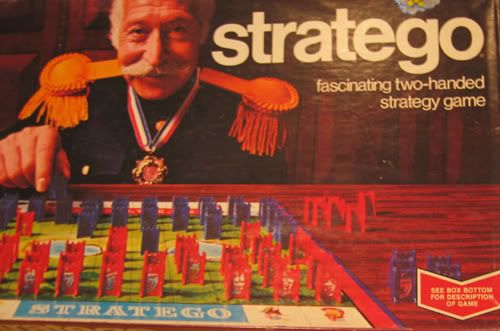
GRIDS, GRAPHS, and SPATIAL THINKING. Battleship (which can be played easily enough with pencil and paper) uses a coordinate grid system. Games like chess and Stratego require players to think in more than one dimension. So does Connect Four. I once had a three-dimensional tick-tack-toe board (I was TERRIBLE at it; fortunately, so were most of my friends). Othello, also known as Reversi, is another good example. There are lots more too.
ATTRIBUTES, LOGIC,and STRATEGIC THINKING. Mastermind (another one that you don't really need a board for). Checkers. Chess. Thinking ahead: if I do this, then she will probably do that. I should move this piece in parcheesi instead of THAT piece because then I might be able to catch that other piece on my next move...I'll test your unknown Stratego piece by using my lowest-ranking piece because it might be a bomb; I can afford to lose a scout but I can't afford to lose a colonel. And of course logic is at the heart of Clue: [drumroll] Miss Scarlett [drumroll] in the kitchen [louder drumroll] with the WRENCH!
NUMBER SENSE and ESTIMATION. You're on Boardwalk in Monopoly. You roll a 5 and a 2. Where are you now? Oriental Avenue--1 space to Go, then 6 more to Oriental. You're on Kentucky Avenue. You roll a 9. There are 10 spaces along each side of the board, and Kentucky is one space after Free Parking--so go to the end of the row--oops, "Go to Jail." You've got a bunch of beans in a space on the mancala board. Where will the last one land if you distribute them, and will that be advantageous to you? You drew an 8 in Sorry--can you tell by looking whether that will get you to the space where your opponent's man is right now?
I hope you get the idea! If you play these games with your kids, it can help to "think aloud" some of your moves and to ask leading questions: "Let's see, I just spelled the word BOX; I get double value for that X, so that's double 8, which is 16; the B is worth 3 points, and 6+3=9, so we're up to 19, and one more point for the O makes 20." "I owe you $36. Here's two twenties. What do you need to give me back for change?" "You told me that E-6 was a hit, but E-5 was a miss, and I know that E-8 was a part of your cruiser; I'll try other spaces in the 6 column." But that's not necessary, and I wouldn't advise pushing it. Unless they're playing absolutely mindlessly, they will pick up some of these concepts even if the game is played in complete and utter silence!
And yes, I DID play lots and lots of board games as a child--why do you ask? In fact, my family's old Monopoly board has a faint track worn into it by the pieces moving steadily around the spaces... (Hint: The railroads are a really good deal in the early stages of Monopoly, a nice steady income, but trade them in mid-game.)
Subscribe to:
Posts (Atom)
