As you very likely know, PDS opened last Wednesday. I must say it's been very nice to be back with the kids again. There's something quite wonderful about children waving enthusiastically at you from halfway across the room and yelling out"Hi, Math Guy!" Makes a man feel worthwhile!
This blog is also back from vacation, so perhaps it will have some children yelling, "Hi, PDSMathGuy blog!" from across the room at it...Or texting "Hi, PDSMathGuy blog!" Or emailing it. Or perhaps not.
In any case, a few little stories, vignettes from the first few days of school to get you smiling (I hope):
***I am presenting a lesson to first graders about odd and even numbers. Part of the followup includes a grid of numbers: 1, 2, 3, and so on. Kids are supposed to determine which numbers are even and which are odd, then color odd numbers blue and even numbers red. One child digs in the colored pencil box and pulls out a blue one, which--alone among all the pencils in the box, it seems--has been sharpened on both ends. "It's a good thing I'm supposed to color the odd numbers blue," she tells me. "This is a blue pencil. And it's very odd."
***A second grade class. A child is paying extremely close attention to her teacher, who is showing the children how to play a game. You can see the child's eyes locked onto the board, her body still, her jaw determined. When she gets up and heads for her seat, there is a Weary Expression on her face. Dropping down on her chair like a rag doll, she shakes her head and looks up at me. "Hard...work," she says emphatically. "Hard...work!"
***Another second grader. The question is to come up with two numbers you can add to make 27. I'm asking him to try the problem in his head, without manipulatives and without writing numbers on a sheet of paper. "Okay, 15," he says proudly. Well, that's a fine start, I tell him, but I'm asking for two numbers and an addition expression, so just saying 15... He nods. "Well, 15," he says, "plus whatever number you put with 15 to make 27."
***Yet another second grader. "What are some things you know about math?" I ask. "Well, ONE thing I know is that math is fun!" he responds immediately. Then, thinking a moment and remembering who he's talking to, he adds, "And I bet you would agree with that!" (P.S. He's right. I would!)
Showing posts with label first and second grade. Show all posts
Showing posts with label first and second grade. Show all posts
Thursday, September 15, 2011


Thursday, October 28, 2010
In Which the Math Guy Is Reminded (Yet Again) of the Importance of Not Making Assumptions
The second graders were measuring. They'd cut out replicas of their feet (exact size, natch) and were busily determining how many of these footprints (feetprints?) it took to equal the length of a shelf, the width of the room, and other various and sundry distances. Then they were converting the number of feetprints (footprints?) to inches and recording it all on a chart.
I plunked myself down next to a child who was recording the number of feetsprint she had needed to cover the distance across a table. She'd written a 7, which sounded reasonable--seven second-grade-sized footsprint looked about right--but what was this next to it? A zero? Seventy? Surely she was putting 70 in the wrong place of the chart. Or she'd mismeasured. Or--
Wait a minute.
It wasn't just a zero. It was a bubble letter--you know, the puffy letters that kids love to make, especially when time is of the essence. The ones that slow kids' work pace down to a crawl. The ones that drive me faintly crazy. The ones that--
Hold on.
Now she was decorating the thing. Shading in part of the inside ring, drawing something unrecognizable in the middle. Decorating--during math time! Bubble letters--during math time! I mean, gee whillikers!
I opened my mouth to say something gentle, yet pointed. Okay, something not-so-gentle yet pointed. Something about saving the artistry for art and getting back to math, and by-the-way was 70 really a reasonable answer, and if you'd been paying closer attention to the math rather than to the art you'd know...But then I didn't. "Tell me about what you're drawing," I said instead, pointing. Just in case my assumption was wrong and there was method to her madness.
"Oh, that's a quarter," she explained, barely looking up.
"The coin?" I asked. "The thing that's worth twenty-five cents?" I peered closer. Okay, now that she'd mentioned it I could see that the bubble-letter zero did indeed resemble a quarter. Fine and dandy, but that didn't explain why she drawn a coin as part of this measurement project. I opened my mouth again...but instead of the pointed comment I'd intended, I found myself with a different response, again a response that didn't automatically assume that she'd messed up.
"Why a quarter?" I asked.
"Well," she said, "when I measured the table I found it was seven and a quarter of my footsprints." She tapped the seven on the chart, then the quarter beside it. "So I wrote seven, and then I drew a quarter. That's why."
And that's why I'm glad I asked!
I plunked myself down next to a child who was recording the number of feetsprint she had needed to cover the distance across a table. She'd written a 7, which sounded reasonable--seven second-grade-sized footsprint looked about right--but what was this next to it? A zero? Seventy? Surely she was putting 70 in the wrong place of the chart. Or she'd mismeasured. Or--
Wait a minute.
It wasn't just a zero. It was a bubble letter--you know, the puffy letters that kids love to make, especially when time is of the essence. The ones that slow kids' work pace down to a crawl. The ones that drive me faintly crazy. The ones that--
Hold on.
Now she was decorating the thing. Shading in part of the inside ring, drawing something unrecognizable in the middle. Decorating--during math time! Bubble letters--during math time! I mean, gee whillikers!
I opened my mouth to say something gentle, yet pointed. Okay, something not-so-gentle yet pointed. Something about saving the artistry for art and getting back to math, and by-the-way was 70 really a reasonable answer, and if you'd been paying closer attention to the math rather than to the art you'd know...But then I didn't. "Tell me about what you're drawing," I said instead, pointing. Just in case my assumption was wrong and there was method to her madness.
"Oh, that's a quarter," she explained, barely looking up.
"The coin?" I asked. "The thing that's worth twenty-five cents?" I peered closer. Okay, now that she'd mentioned it I could see that the bubble-letter zero did indeed resemble a quarter. Fine and dandy, but that didn't explain why she drawn a coin as part of this measurement project. I opened my mouth again...but instead of the pointed comment I'd intended, I found myself with a different response, again a response that didn't automatically assume that she'd messed up.
"Why a quarter?" I asked.
"Well," she said, "when I measured the table I found it was seven and a quarter of my footsprints." She tapped the seven on the chart, then the quarter beside it. "So I wrote seven, and then I drew a quarter. That's why."
And that's why I'm glad I asked!
Saturday, March 20, 2010
From LOGO to Ladybugs

Early in my teaching career, PDS decided to provide each lower school classroom with a computer. Well, I should probably say "so-called computer," as the machine that graced my own classroom bore practically no resemblance to the current PDS fleet of laptops.
The machine, IIRC (and I'm sure I do RC), consisted of a keyboard, a monitor with a black-and-green screen, a separate drive for floppy disks (and floppy they were), and a whole mess of unnecessary wires. No mouse, no trackpad. No internet connection, no CD drive. No color, no sound. No bells, no whistles.
Oh, there was a printer of some description, a noisy and unreliable machine that routinely shredded the paper you fed it and printed letters better suited to connect-the-dots than to actual, you know, legibility.
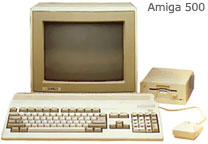
The machine, which looked something like the one pictured above (minus the mouse), could do two things. The first was word processing, or what passed for it during the early-to-mid-eighties. The word processing was courtesy of a program called Bank Street Writer, which had been developed specifically for use in "educational settings." From where I sat it was hard to see why anyone had bothered. Bank Street Writer was clunky. It was slow. It was inefficient. It was practically useless. You had to use the keyboard arrows to select text for editing, which took forever, and they kept throwing the mid-eighties version of dialogue boxes at you when you did ("Are you sure you want to select this block of text? Y/N" "Are you REALLY sure? Y/N" "Are you positive? Y/N" "Are you sure you want to move it to the indicated place? Y/N" "Do you have any idea why we are asking all these questions? Y/N" "Don't you wish you'd decided to write this out longhand instead? Y/N.") Saving was a slow and frustrating process, as was retrieving previously-saved files. There was one difficult-to-read font (though there may have been two sizes, I'm not sure), and formatting was just about nonexistent. After a number of ol' college tries to find any way in which this program represented an improvement over almost anything else, I washed my hands of it and went back to the trusty old typewriter.

The other program was better. It was called LOGO, which was always written in capital letters though I'm not sure it actually stood for anything. LOGO allowed kids to do simple programming in a geometric context. You had what they called a turtle, which actually looked like a triangle but what the hey, and it sat there on the screen waiting to be told what to do. Kids could then type in various commands to make the turtle move. Typing in "BK 20," for instance, got the turtle to go 20 units in reverse (BK=backward, clever huh? and you thought it stood for Burger King). "FD 5" made it go forward 5 units. As it moved, it drew a line behind it. You couldn't make it go directly up or down, but you COULD make the turtle turn. Typing "RT 90" instructed it to spin 90 degrees to the right; "LT 135" got it to...well, you can figure it out.
There were lots of things to like about Logo, scuse me, LOGO. Kids had to type the directions using a specific format: if they typed "FD85" instead of "FD 85," the program would give them an error message. That made the children focus on precision--and helped demystify the computer and its abilities ("yup, it can do amazing things--but it CAN'T figure out what to do when it sees 'LT50' because NO ONE TOLD IT WHAT TO DO when someone mistypes something"). Kids very much enjoyed pretending to be the turtle and giving each other directions: "Okay, forward six steps..." The spatial reasoning aspect of LOGO was excellent--which way do I have to turn if I want to go straight up? what number do I need to input? And the use of left and right and the intro to angle measures were both valuable.
LOGO did have an issue. One goal of the software was to have kids program the turtle to make certain figures--squares, houses, and so on. Can you make a triangle? The letter Z? How? A few kids did get into this. Many, however, quickly decided that the REAL point of the program was to get the turtle to make random lines. We got lots of "FD 400" "FD 40" "FD 400" "FD 989"-style programs in which the turtle made a line to the right, disappeared off the right edge of the screen, came back on the left, and continued to do this for as many commands as the children had told it while the onlookers giggled. Another popular activity was to ignore the FD and BK commands in favor of having the turtle spin endlessly in place: LT 900, RT 42, LT 656, RT 851. Somebody figured out that if you told the turtle to make a turn of 1 unit before doing the FD commands, you could eventually have the turtle criss-cross the entire screen, effectively whiting it all out.
These were cute, and they required some thought at first (especially the white-out one), but once that initial thinking was over the activities quickly became kind of useless educationally. Kids weren't learning anything by repeatedly typing in BK 77 BK 77 BK 77, and the more they did that the less willing they seemed to want to engage in the actual making of shapes. There was something highly motivating about watching the turtle spin this way and that, and in contrast the work of plotting how to make a square seemed considerably less compelling. How you gonna keep 'em down on the farm, as the WWI song went, after they've seen Paree? Under these circumstances LOGO rapidly became less a tool for learning than a diversion for entertainment, and after a couple of years that began to sour me on the whole program. When "real" computers came along LOGO and its derivatives were not high on my list.
This year, though, I returned to my LOGO-ish roots. For our ongoing geometry unit in the 1-2 classes, we decided that I would pull kids during some of their math times and do some computer work. I'd pull out the laptops and work with kids on one or more of the virtual manipulatives at the Utah Sate University website: http://nlvm.usu.edu/. A lot of these materials are really excellent. Rods don't fall on the floor. Pattern block designs don't get wrecked when someone accidentally shakes the table. Virtual rubber bands don't break when you stretch them across a virtual geoboard. While not all materials on the site are equally great, many are quite wonderful.
But after looking through the various manipulatives on the site, I decided to focus on the most LOGOlike one: a program called Ladybug Leaf.
 (If you click on Geometry on the home page, it will be about 6 or 7 buttons down in the list.) The object of Ladybug Leaf is to direct a ladybug, LOGOstyle, to hide under a leaf. The graphics are far clearer and more engaging than they were in the old LOGO program. The ladybug is a real ladybug; the bug moves in clearly demarcated units; the leaf is a real leaf. The order of commands remains on the screen as the ladybug moves, with each command flashing briefly as the ladybug carries out that particular action. It's easy to replace a command, too--much easier than it used to be! True, FD 25 and LT 90 are things of the past in this activity, and I do kind of miss them. Instead, there are buttons you can click that will move the bug one unit forward or backward, or spin it 45 or 90 degrees to the left or the right. On the other hand, angle measures aren't exactly a staple of first and second grade mathematics, and you can always introduce the terms 45 and 90 degrees yourself.
Anyhow, the kids have been very much enjoying their venture into LOGOlike technology--and, I would like to think, learning important stuff along the way. It helps that in the last twenty-plus years I have learned a few things myself. In particular, I made sure to focus this time around on specific tasks: hide the bug under the leaf, move the leaf and hide it again, make a square, make a triangle, make a house (a house! See below, courtesy of one very thoughtful and dogged second grader)

There's nothing wrong with entertainment for its own sake, but I want a little more from, you know, school.
And how can I complain when that first grade girl who is ordinarily so reserved and so serious, after successfully planning a route to the leaf for her ladybug, celebrated by standing up and chanting "Oh yeah, oh yeah" while doing some disco moves?
Now if only someone could make some improvements to Bank Street Writer...
Wednesday, November 18, 2009
How to Measure: An Illustrated Manual
The Definitive Treatise, by PDS First Graders.
1. “There can’t be gaps when you measure. You have to push the measuring things together, like this.”

2. “And you can’t make the rods all zigzag. You have to put them together in a straight line, like this. Don’t get off track.”


3. “The first thing is you have to estimate how many rods will fit.”

4. “You should look at it carefully. Then you can use your fingers to help you estimate.”

5. “You start by putting the first rod down so its end is right at the edge of the thing you’re measuring.”

6. “Then put more of them along the side, like this.”

7. “Go until you get to the other end of what you’re measuring! Then count how many rods you used.”

And now you know how to measure!
1. “There can’t be gaps when you measure. You have to push the measuring things together, like this.”

2. “And you can’t make the rods all zigzag. You have to put them together in a straight line, like this. Don’t get off track.”


3. “The first thing is you have to estimate how many rods will fit.”

4. “You should look at it carefully. Then you can use your fingers to help you estimate.”

5. “You start by putting the first rod down so its end is right at the edge of the thing you’re measuring.”
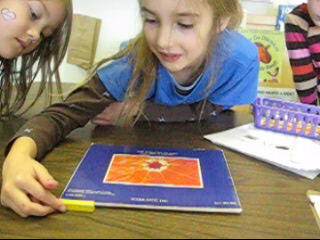
6. “Then put more of them along the side, like this.”

7. “Go until you get to the other end of what you’re measuring! Then count how many rods you used.”

And now you know how to measure!
Monday, November 9, 2009
If Left and Right Are Opposites, What About Remaining and Wrong?
"Look at the four cards I just gave you," I instructed the first graders I was working with today. We were warming up for some measurement work by reviewing some concepts from last month. "Look at the numbers on the cards. Show me an odd number...good job. Show me an even number...excellent! Which number is the least? Show me a number that's between 5 and 9." And on it went like that, culminating in the following exchange:
Me: "Okay, now find the greatest number. Put that card here in the middle of the table."
Children: [follow directions]
Me: "Now, look at the cards that you still have. Which is the greatest of the numbers that are left?"
One Child [looking back and forth at the three remaining cards, face up on the table]: "Which way is left, again?"
Oh, to have directional words that have just one meaning. That'd be great, right? (Wait...which way is right, again?)
Me: "Okay, now find the greatest number. Put that card here in the middle of the table."
Children: [follow directions]
Me: "Now, look at the cards that you still have. Which is the greatest of the numbers that are left?"
One Child [looking back and forth at the three remaining cards, face up on the table]: "Which way is left, again?"
Oh, to have directional words that have just one meaning. That'd be great, right? (Wait...which way is right, again?)
Friday, October 30, 2009
People v. Tables
"I am going to have a party," read the question given to a number of our 1-2 students the other day. "I want to invite ___ people." (The blank is standard: everybody gets a different number, which a) cuts down on the Problem of Roving Eyes and b) allows us to give somewhat harder numbers to kids who are ready for a challenge while keeping the same problem frame for everyone.)
"I have ____ tables where my guests can sit," the problem continues. "Each table has room for _____ people. Do I have enough tables, or do I need to get more?"
Different kids had different ways of attacking the problem, as usual. Some sketched the tables, drew chairs around them, and counted by ones. Others dispensed with the chairs and simply wrote the number at each table, then counted by that number if they knew how. A couple didn't bother with a sketch at all. One or two made groups with checkers or other materials--7 groups of 6 checkers, for instance, to represent 7 tables with 6 people at each--and then checked the number of people to see if they'd gone over or not. The strategies were generally quite accurate, if not consistently efficient: the next step will be to move kids away from the pictures and toward more abstract skip-counting and other strategies.
At any rate, children needed to show or describe their work and then answer the question (which, if you recall, had something to do with whether there were enough tables or whether we needed to get more). Several children didn't recall--they needed a reminder to do this part--but eventually we had the answers we sought.
"I have enough tables," one child wrote confidently and accurately. (Actually, she wrote "enuff," but let that pass...)
"You have enough tables. Am I rite?" wrote another child, perhaps a little less confident than the first. (Yup, I told him, you're rite. Um, right.)
"You need to get more tables," wrote a third responder, "because seven tables is going to be a smaller number of people. You need 8 tables." She included a careful sketch with the correct number of heads jowl by jowl at each table: an arrow then pointed to the last table, with the helpful label "extra."
"I have to sell one more chair," wrote still another girl. A somewhat convoluted way of saying that she not only had enough tables--she had an extra seat. I'm not entirely clear whether the sale would be an auction for the right to attend the party, or simply an attempt to convert an unwanted and unnecessary item into cold hard cash. Either way, this is a girl who knows the value of a buck.
And perhaps my favorite: the boy who discovered that he had space for 52 when he only needed to seat 49. After showing his method, he concluded: "You need more people."
"I have ____ tables where my guests can sit," the problem continues. "Each table has room for _____ people. Do I have enough tables, or do I need to get more?"
Different kids had different ways of attacking the problem, as usual. Some sketched the tables, drew chairs around them, and counted by ones. Others dispensed with the chairs and simply wrote the number at each table, then counted by that number if they knew how. A couple didn't bother with a sketch at all. One or two made groups with checkers or other materials--7 groups of 6 checkers, for instance, to represent 7 tables with 6 people at each--and then checked the number of people to see if they'd gone over or not. The strategies were generally quite accurate, if not consistently efficient: the next step will be to move kids away from the pictures and toward more abstract skip-counting and other strategies.
At any rate, children needed to show or describe their work and then answer the question (which, if you recall, had something to do with whether there were enough tables or whether we needed to get more). Several children didn't recall--they needed a reminder to do this part--but eventually we had the answers we sought.
"I have enough tables," one child wrote confidently and accurately. (Actually, she wrote "enuff," but let that pass...)
"You have enough tables. Am I rite?" wrote another child, perhaps a little less confident than the first. (Yup, I told him, you're rite. Um, right.)
"You need to get more tables," wrote a third responder, "because seven tables is going to be a smaller number of people. You need 8 tables." She included a careful sketch with the correct number of heads jowl by jowl at each table: an arrow then pointed to the last table, with the helpful label "extra."
"I have to sell one more chair," wrote still another girl. A somewhat convoluted way of saying that she not only had enough tables--she had an extra seat. I'm not entirely clear whether the sale would be an auction for the right to attend the party, or simply an attempt to convert an unwanted and unnecessary item into cold hard cash. Either way, this is a girl who knows the value of a buck.
And perhaps my favorite: the boy who discovered that he had space for 52 when he only needed to seat 49. After showing his method, he concluded: "You need more people."
Friday, September 18, 2009
Learning from the DVD...Player
Teachers of today can choose from a wide array of technologies to spice up their lessons and increase students' understanding. There's Powerpoint, of course, and calculators, smart boards and video cameras, wikis and spellcheckers, voice-to-text programs and DVDs, Excel spreadsheets and Activote systems, GPSes and, um, electric pencil sharpeners; the list goes on.
Most of these educational technologies get plenty of respect within the educational world. (Well, maybe not the pencil sharpeners.) Whole conferences are organized around these technologies and how they can help teachers do a better job of preparing students for the 21st century [Q: At what point will we start saying "preparing students for the 22nd century"?]. BUT there is one technology that is sadly overlooked. It is the Rodney Dangerfield of the educational technology world. I refer, of course, to the lowly DVD player. Not the DVD; the player.

"How did you know so quickly that 8 + 8 was 16?" I asked a first grade girl earlier this week. (If this question sounds familiar, it's probably because you read the previous entry in this blog.)
"Well," she said, "we have this DVD player at home and it has arrows. And if you want to speed through the movie it says 2, 4, 8, 16, 32, and then it goes back to 2 again. And I know that 2+2 is 4 and that 4+4 is 8, so 8+8 must be 16, and I guess that 16+16 would be 32. But then the pattern stops because it goes back to 2 and 32+32 is...something, but it isn't 2."
What can I say? Clearly, we should as a nation reduce our spending on old-boring-and-ineffective technologies such as computers, projectors, smart boards, and digital cameras, and load up classrooms instead with DVD players. Who's with me?
--Actually, this is a really good example of a child not only noticing but using math in everyday life. No one taught her that 8 + 8 was 16. She was struck by a sequence of numbers that appeared in her environment, and spent time and energy deciphering the pattern--learning, and evidently mastering, the fact that 8+8=16 along the way. This is the kind of thinking we always want to see in our students. As our report form puts it, one of our goals for children is that they "recognize and construct mathematics in daily life." It's lovely to see such a clear example.
Most of these educational technologies get plenty of respect within the educational world. (Well, maybe not the pencil sharpeners.) Whole conferences are organized around these technologies and how they can help teachers do a better job of preparing students for the 21st century [Q: At what point will we start saying "preparing students for the 22nd century"?]. BUT there is one technology that is sadly overlooked. It is the Rodney Dangerfield of the educational technology world. I refer, of course, to the lowly DVD player. Not the DVD; the player.

"How did you know so quickly that 8 + 8 was 16?" I asked a first grade girl earlier this week. (If this question sounds familiar, it's probably because you read the previous entry in this blog.)
"Well," she said, "we have this DVD player at home and it has arrows. And if you want to speed through the movie it says 2, 4, 8, 16, 32, and then it goes back to 2 again. And I know that 2+2 is 4 and that 4+4 is 8, so 8+8 must be 16, and I guess that 16+16 would be 32. But then the pattern stops because it goes back to 2 and 32+32 is...something, but it isn't 2."
What can I say? Clearly, we should as a nation reduce our spending on old-boring-and-ineffective technologies such as computers, projectors, smart boards, and digital cameras, and load up classrooms instead with DVD players. Who's with me?
--Actually, this is a really good example of a child not only noticing but using math in everyday life. No one taught her that 8 + 8 was 16. She was struck by a sequence of numbers that appeared in her environment, and spent time and energy deciphering the pattern--learning, and evidently mastering, the fact that 8+8=16 along the way. This is the kind of thinking we always want to see in our students. As our report form puts it, one of our goals for children is that they "recognize and construct mathematics in daily life." It's lovely to see such a clear example.
Monday, September 14, 2009
That's All She (w)Rote

You have 8 cubes, I say.
The child, a first grader, nods happily. He's just counted them, accurately, and showed me how you could split them up so that we each had the same number (4 apiece, if you were curious), and answered several other questions about them as well.
What if you had 8 cubes and I had 8 cubes too? I ask. How many would we have in all?
This isn't necessarily an easy question for six-year-olds, and they vary in their approaches--also in the speed with which they answer. 28, says the boy, just as automatically as you please. There's no lack of confidence here. (Not a lot of accuracy, either, but hey, it's still early in the year.)
28? I ask, just to make sure.
28, he says. No. I mean, um, 34. Yeah, 34.
34, I repeat, resisting the temptation to ask, Regis-style, whether this is his final answer. And how did you know?
Oh, I didn't know, he says with a grin. I guessed.
Okay, I say, and go on to do a few more activities with him. I wrap up with a nice open-ended question: What else do you know about math that you'd like to tell me?
Well, he says eagerly, one thing I know is that 8 plus 8 is 16...
SMACK! goes my hand (metaphorically at least) against the side of my head.
This little anecdote nicely illustrates the difference between knowing a fact and KNOWING it. This boy knew that 8+8 was 16, but he didn't KNOW it--that is, while he could repeat it, he couldn't use that information in a real-life context. His verbal knowledge isn't yet supported by his conceptual understanding.
There's nothing wrong with learning some kinds of things by rote. Indeed, sometimes it's necessary. It's just that you have to be careful with kids and not automatically assume they KNOW everything they know....if you know (KNOW?) what I mean!
Friday, June 5, 2009
How to Annoy a First Grader

I'm sure there are other ways too, but one really good way is to ask children to make an estimate.
First, present a "how many" question where the answer's clearly more than 10 or 15 or so: how many cubes in a bag, how many times they can hop in one minute, how many pages in a book, that kind of thing.
Then, ask them to estimate the total, but insist that they give you a "round" number--that is, a multiple of ten (10, 20, 30...).
From a math perspective, asking for a round number makes plenty of sense. Part of the purpose of an estimate is to use numbers that are easy to work with. "If this bag has about 20 cubes, and this one has about 60 cubes, about how many are there in both bags together?" is easier to deal with than "If this bag has about 19 cubes, and the other one has abut 63 cubes..."
But from a kid's-eye perspective, it's frustrating (or "fruster-rating," as some children say) to have to give a round number. That's because children of this age tend to view the purpose of estimation as "guessing the right answer," not simply coming up with a number you can use when you don't need, or can't get, an exact answer. By limiting their choices to multiples of ten, I make it very difficult to choose the correct total.
And they hate that. Recently I insisted that kids give me a round number for an estimate. "How many say it's about 10?" I said. "About 20? About 30? Who says about 40? Raise your hand..." Several of the children refused to vote. (Insurrection!) And when the true total was revealed to be 42, one child said to me reproachfully "No fair! You didn't let us pick that one!"
So enforcing a round number estimate is one good way to annoy a first grader. Here's another way, related to the first. Today we were working on probability. Partners were given an envelope with five cards. They recorded the number of red cards and the number of black cards, and then made estimates of how many of each color they would get if they pulled a card from the envelope 25 times (replacing the card after pulling it, of course). Next, they tried it out and recorded the results. Finally, they needed to decide if their initial estimate was "close" or "not very close."
One pair predicted 22 blacks and 3 reds. Not a bad prediction, given that they had 4 black cards and just 1 red one in their envelope. These children were not just interested in the results; they were invested. "Come on, BLACK!" they'd say, pulling out a card and discovering that it was...the two of spades. (Fist-pumping ensued.) Then, after a while, one of them commented "We need another couple of reds," and lo and behold, whaddaya know, the next card out of the envelope was the five of hearts! (More fist pumps.) And amazingly enough, after 25 pulls they had--wait for it--22 blacks and 3 reds. An astonishing coincidence, to be sure.
"The page just says 'close' or 'not very close,'" they complained to me after they were finished. "Where's the one for 'we got it exactly right'?"
"Oh, there isn't one," I said. "You can mark 'close.' The point of a prediction like this is to be close, that's all. That's what we care about."
"Yeah," they said, "but we got it exactly right."
"So you did," I agreed, "but when you make an estimate or a prediction you are just trying to get near the real total. Your estimate was a good one. But it would have been just as good if you had predicted 21 blacks and 4 reds. Or even 20 blacks and 5 reds. Just circle 'close.'"
Fist-pumping was now over. The two exchanged unhappy glances, returned to their seats, and circled 'close.' Against their wills, of course.
Oh well-they'll get there eventually. I hope! In the meantime, feel free to annoy your own personal first grader all you like with these methods...
Friday, May 29, 2009
Things Your Children Probably Shouldn't Be Telling Us, Part 1
So we were working on time in the 1-2s this week. Today, the kids named and ordered various units of time, from milliseconds and seconds up to centuries and millenniums, and explained what they knew of the relationships between them, using nice NUMBER SENTENCES (60 sec = 1 min, 1 day = 24 hours, etc). On the whole, they did quite well, though why "half an hour" and "5 minutes" don't count as separate units of time was a bit mysterious for a few of our first graders. Next year--
Anyhow, after this lead-in, I asked children to fill out a sheet about time units. The structure was simple enough. "It takes about one SECOND to..." was the first one, and kids were supposed to think of an activity that takes about one second. Then they followed it with one minute, one hour, and one day.
The responses were fun and revealing of children's understanding: one second to "squash a bug," "pick up a feather," or "say four letters of the alphabet," one hour to "clean my room" or "draw a perfect picture" (quick, tell Picasso!), one day to "make a really good sculpture."
My personal favorite, though? "It takes about one minute to do my homework." Given that mathups, reading, and spelling alone are supposed to take at least 20-25 minutes each night, this is the sort of statement that is perhaps better left unsaid. Ah well--by high school I'm sure this child will have figured that out!
Anyhow, after this lead-in, I asked children to fill out a sheet about time units. The structure was simple enough. "It takes about one SECOND to..." was the first one, and kids were supposed to think of an activity that takes about one second. Then they followed it with one minute, one hour, and one day.
The responses were fun and revealing of children's understanding: one second to "squash a bug," "pick up a feather," or "say four letters of the alphabet," one hour to "clean my room" or "draw a perfect picture" (quick, tell Picasso!), one day to "make a really good sculpture."
My personal favorite, though? "It takes about one minute to do my homework." Given that mathups, reading, and spelling alone are supposed to take at least 20-25 minutes each night, this is the sort of statement that is perhaps better left unsaid. Ah well--by high school I'm sure this child will have figured that out!
Thursday, May 28, 2009
Finding the Center
One of the perks about being a member of NCTM (http://nctm.org, the National Council of Teachers of Mathematics) is that you get a subscription to a journal called, what else, Teaching Children Mathematics. This journal has a monthly feature called "Problem Solvers," which presents an open-ended problem and encourages teachers to try it with their classes. Teachers are then invited to write up their experiences and send 'em in. From time to time I've tried these problems out, and once I even got around to sending in my reflections.
Anyway, a recent Problem Solvers challenge caught my eye: How would you go about finding the geographic center of the United States (minus Alaska and Hawaii)? O-ho! I thought. This will be an interesting problem to do with all the grade levels I work with! But then field trips and special events got in the way, and so did division and fractions and 3-d geometry and other such valuable topics--so in the end I managed to do the problem only with a few 4th graders and a few 1st graders.
At some point I'll talk more about the 4th graders, who generally did quite well--they showed some sophisticated thinking about the assignment, and made use of a number of different mathematical skills to come up with an answer. This post, though, will be about the 1st graders, whose work was...um...
*************************************************
For the children , this was one of the easiest questions I'd asked all year. “It’s right here,” said one girl, touching the middle of the border between Kansas and Nebraska. The others nodded agreement and, not to be outdone, put their fingers on roughly the same spot themselves. That part of the Great Plains has never been so crowded.
This was a good estimate—a very good estimate, in fact, but I was looking for an explanation of how they'd figured it out too. When no clear explanation was forthcoming--in fact, when there was no explanation of any kind--I asked whether there were any tools they could use to show me what they were thinking. When I said tools I had in mind, oh, rulers, or some other kind of measuring device. They did not.
“A jackhammer?” suggested one boy.
"You could use a compass," said the girl who had made the initial estimate. "You would walk with the compass. You can start anywhere, like in California. Then you walk this way.” She put her finger near San Francisco and slid it eastward on the map. “When you get there, you stop.”
“How do you know when you’re there?” I asked.
She shrugged. “Because you’ll get to that place, and then you’ll be there.” She was too polite to say Duh!, but you could hear it all the same.
“What do the rest of you think?” I inquired. A chorus of “I agree”s and “Uh-huhs” rose from the other children. I believe this is called proof by intimidation.
I decided we'd better back up. “How about this table?” I asked. “Where’s its center? And how do you know?” Several hands slapped down in a place reasonably close to the center, if not the exact spot. The center, they explained, had to be in the middle of the lines that divided the table in half. Duh! Again, politeness reigned, but I knew what was what.
“So now we know about the center of the table,” I said. “I wonder if that might help us find the center of the country.” I opened up the map again. “What do you think?”
There was brief discussion. One child pointed out that the United States wasn’t a nice regular shape, such as a circle or a square, so it didn’t really have a center. Another argued that the whole world would have a center, “because that would be a sphere and then you could find the middle of it.” But they all deferred to a girl who cut to the chase. "The center would be right here," she said, stabbing a forefinger at a spot in the middle of Kansas, just south of the original place chosen. “That’s the center.”
Back we’d come to our starting point. “How do you know?” I asked once more, feeling like the twenty-first century version of a broken record and hoping she'd say something about lines that divided the country in half...
Nope. The child looked at me with something resembling pity. “You go up in a plane,” she said, “and then you can see where the center is and you go there.” Duh!
From which I conclude one or more of the following:
*First graders seriously underestimate the size of the country.
*First graders see no reason to calculate the exact position of a center when eyeballing it will do.
*Sometimes it’s really hard to explain your thinking, especially just before lunch on a Monday morning.
Oh well--onward!
P. S. If you'd like to know more about the geographic center, here's a rundown: http://en.wikipedia.org/wiki/Geographic_Center_of_the_Contiguous_United_States.
Anyway, a recent Problem Solvers challenge caught my eye: How would you go about finding the geographic center of the United States (minus Alaska and Hawaii)? O-ho! I thought. This will be an interesting problem to do with all the grade levels I work with! But then field trips and special events got in the way, and so did division and fractions and 3-d geometry and other such valuable topics--so in the end I managed to do the problem only with a few 4th graders and a few 1st graders.
At some point I'll talk more about the 4th graders, who generally did quite well--they showed some sophisticated thinking about the assignment, and made use of a number of different mathematical skills to come up with an answer. This post, though, will be about the 1st graders, whose work was...um...
*************************************************
For the children , this was one of the easiest questions I'd asked all year. “It’s right here,” said one girl, touching the middle of the border between Kansas and Nebraska. The others nodded agreement and, not to be outdone, put their fingers on roughly the same spot themselves. That part of the Great Plains has never been so crowded.
This was a good estimate—a very good estimate, in fact, but I was looking for an explanation of how they'd figured it out too. When no clear explanation was forthcoming--in fact, when there was no explanation of any kind--I asked whether there were any tools they could use to show me what they were thinking. When I said tools I had in mind, oh, rulers, or some other kind of measuring device. They did not.
“A jackhammer?” suggested one boy.
"You could use a compass," said the girl who had made the initial estimate. "You would walk with the compass. You can start anywhere, like in California. Then you walk this way.” She put her finger near San Francisco and slid it eastward on the map. “When you get there, you stop.”
“How do you know when you’re there?” I asked.
She shrugged. “Because you’ll get to that place, and then you’ll be there.” She was too polite to say Duh!, but you could hear it all the same.
“What do the rest of you think?” I inquired. A chorus of “I agree”s and “Uh-huhs” rose from the other children. I believe this is called proof by intimidation.
I decided we'd better back up. “How about this table?” I asked. “Where’s its center? And how do you know?” Several hands slapped down in a place reasonably close to the center, if not the exact spot. The center, they explained, had to be in the middle of the lines that divided the table in half. Duh! Again, politeness reigned, but I knew what was what.
“So now we know about the center of the table,” I said. “I wonder if that might help us find the center of the country.” I opened up the map again. “What do you think?”
There was brief discussion. One child pointed out that the United States wasn’t a nice regular shape, such as a circle or a square, so it didn’t really have a center. Another argued that the whole world would have a center, “because that would be a sphere and then you could find the middle of it.” But they all deferred to a girl who cut to the chase. "The center would be right here," she said, stabbing a forefinger at a spot in the middle of Kansas, just south of the original place chosen. “That’s the center.”
Back we’d come to our starting point. “How do you know?” I asked once more, feeling like the twenty-first century version of a broken record and hoping she'd say something about lines that divided the country in half...
Nope. The child looked at me with something resembling pity. “You go up in a plane,” she said, “and then you can see where the center is and you go there.” Duh!
From which I conclude one or more of the following:
*First graders seriously underestimate the size of the country.
*First graders see no reason to calculate the exact position of a center when eyeballing it will do.
*Sometimes it’s really hard to explain your thinking, especially just before lunch on a Monday morning.
Oh well--onward!
P. S. If you'd like to know more about the geographic center, here's a rundown: http://en.wikipedia.org/wiki/Geographic_Center_of_the_Contiguous_United_States.
Wednesday, May 20, 2009
Psst! Rules!
PDS is a progressive school. right? Right. So it doesn't bother with silly things like rules, right?
Well--no. We do bother with rules. As well we should. The first rule of the school is, or used to be, "No one may interfere with the learning of another." A good rule, and a sensible one, which recognizes the important distinction between rights and responsibilities, even if it lacks the pizazz of what used to be the school's second rule, "Windows are not doors."
We have plenty of other rules regarding behavior, too, many of them developed by the children themselves (most of these begin with the word No, as in No hitting/No kicking/No biting/No poking people with sharp sticks/No knocking over other people's block buildings) or by the children in conjunction with a teacher (these are stated much more positively--Walk in the halls/Be nice to people/Share classroom materials/Treat other people's block buildings with respect). My favorite of these from my classroom-teacher days was Eat regularly, which had nothing to do with having frequent snacks but was one second grader's attempt to condense No burping at lunch and No opening your mouth while you're eating to show people what's inside into one relatively positive statement...
But the rules I want to discuss in this post are math rules. Yes! Math rules, as I use the term, are statements about math that are always true. We encourage children to come up with these rules as they work on problems and as they talk about math. Here are 3 examples, named for the children who first suggested them:

 These may seem basic to you, and of course they are. None of these will make the pages of American Mathematical Monthly. They've all been discovered before. On the other hand, let's keep in mind that these are first and second grade children who are just beginning to make sense of the number system. The idea that numbers will always behave in a certain way is by no means obvious. Most things about school aren't that predictable. Think about reading: the letter o can stand for several different sounds, some words add an s in the plural while others add es, a word like set or right can have multiple meanings. Math is different. Math is a little more--reliable.
So we ask children to look for these always situations in math. We ask them to think carefully about how numbers work, about whether a particular result will happen no matter what or whether it will happen only sometimes. The benefits, I think, are clear. A child who recognizes that an odd number plus an even number will always be an odd number is thinking hard about numbers and their properties. She's doing some basic number theory; she's acting like a scientist, making and then testing a conjecture. A child who sees that adding or subtracting zero never changes the original number is finding a pattern, generalizing from special cases, and boldly going where (to the best of his knowledge, anyway) no man has gone before.
Yes, we could tell children that odd + even is always odd, and very often we do just that. But it's more powerful, and the effects are longer-lasting, if children come to discover these rules themselves. Now if you'll excuse me, I need to go determine whether every even number greater than 2 can be written as the sum of two primes...
Well--no. We do bother with rules. As well we should. The first rule of the school is, or used to be, "No one may interfere with the learning of another." A good rule, and a sensible one, which recognizes the important distinction between rights and responsibilities, even if it lacks the pizazz of what used to be the school's second rule, "Windows are not doors."
We have plenty of other rules regarding behavior, too, many of them developed by the children themselves (most of these begin with the word No, as in No hitting/No kicking/No biting/No poking people with sharp sticks/No knocking over other people's block buildings) or by the children in conjunction with a teacher (these are stated much more positively--Walk in the halls/Be nice to people/Share classroom materials/Treat other people's block buildings with respect). My favorite of these from my classroom-teacher days was Eat regularly, which had nothing to do with having frequent snacks but was one second grader's attempt to condense No burping at lunch and No opening your mouth while you're eating to show people what's inside into one relatively positive statement...
But the rules I want to discuss in this post are math rules. Yes! Math rules, as I use the term, are statements about math that are always true. We encourage children to come up with these rules as they work on problems and as they talk about math. Here are 3 examples, named for the children who first suggested them:


 These may seem basic to you, and of course they are. None of these will make the pages of American Mathematical Monthly. They've all been discovered before. On the other hand, let's keep in mind that these are first and second grade children who are just beginning to make sense of the number system. The idea that numbers will always behave in a certain way is by no means obvious. Most things about school aren't that predictable. Think about reading: the letter o can stand for several different sounds, some words add an s in the plural while others add es, a word like set or right can have multiple meanings. Math is different. Math is a little more--reliable.
So we ask children to look for these always situations in math. We ask them to think carefully about how numbers work, about whether a particular result will happen no matter what or whether it will happen only sometimes. The benefits, I think, are clear. A child who recognizes that an odd number plus an even number will always be an odd number is thinking hard about numbers and their properties. She's doing some basic number theory; she's acting like a scientist, making and then testing a conjecture. A child who sees that adding or subtracting zero never changes the original number is finding a pattern, generalizing from special cases, and boldly going where (to the best of his knowledge, anyway) no man has gone before.
Yes, we could tell children that odd + even is always odd, and very often we do just that. But it's more powerful, and the effects are longer-lasting, if children come to discover these rules themselves. Now if you'll excuse me, I need to go determine whether every even number greater than 2 can be written as the sum of two primes...
Wednesday, April 15, 2009
Ways to 100
Formal multiplication instruction, at PDS as elsewhere, is generally the province of third, fourth, and fifth grades. But informally, multiplying comes up considerably earlier than that.
Our kindergarteners recently sorted collections of objects into groups of two, three, or more to see how many groups they had and how many were left over--multiplicative thinking at work. Counting quarters, dimes, or nickels uses simple multiplication concepts. So does telling time on an analog clock.
For that matter, any time children read, write, or model two- or three-digit numbers, they're using basic ideas of multiplication. Our decimal system, after all, is built on groups--groups of ones, tens, hundreds, and on and on.
The pictures below show groupings of 100 objects created by first and second graders. You can see the connection to multiplication: ten groups of ten, two groups of 50, five groups of 20, even 25 groups of four (though one of the dice here appears to have fallen off). Work like this can help children considerably when it's time for a formal introduction of the topic.


 You may want to enlarge this last one to see what numbers are on the dice...
Our kindergarteners recently sorted collections of objects into groups of two, three, or more to see how many groups they had and how many were left over--multiplicative thinking at work. Counting quarters, dimes, or nickels uses simple multiplication concepts. So does telling time on an analog clock.
For that matter, any time children read, write, or model two- or three-digit numbers, they're using basic ideas of multiplication. Our decimal system, after all, is built on groups--groups of ones, tens, hundreds, and on and on.
The pictures below show groupings of 100 objects created by first and second graders. You can see the connection to multiplication: ten groups of ten, two groups of 50, five groups of 20, even 25 groups of four (though one of the dice here appears to have fallen off). Work like this can help children considerably when it's time for a formal introduction of the topic.


 You may want to enlarge this last one to see what numbers are on the dice...
Subscribe to:
Posts (Atom)
