It was a He-Man action figure, I think, that started the trouble on that spring day early in my teaching career. If you're old enough to remember they heyday of He-Man and his, um, business associates (the name Skeletor ring a bell?), congratulations. (And you do need to have some age on you, as these figures were popular in my kindergarten classroom around the same time as the A-Team and just before Cabbage Patch Kids (bless their ***** little hearts) and Transformers.) If you're not old enough to remember the excitement, if you grew up outside the cultural influence of the USA, or if your memory is like a sieve, never mind. It was a toy, that's all you need to know; a coveted toy, a toy with a definite cool factor, the kind of toy that conferred automatic social standing on its owner, even in kindergarten.
Anyhow, there was a stray He-Man figure, a slightly dusty one that someone had found wedged halfway under a shelf near the block corner. He immediately claimed it as his own property, based on two incontrovertible legal principles (incontrovertible among five-year-olds, at least): first, he'd found it; and second, just in case that didn't carry any weight with others, he was almost certain he'd lost that very figure some time earlier, and lost it in a part of the room that was surprisingly near the shelf in question. At first no one challenged the incontrovertibility of these claims, and he was happily showing it off to all his friends, and growing no doubt in social standing all the while...when up came another child, who promptly rocked the boat by claiming this very He-Man as his own property.
It soon became apparent that this was going to be one of those situations: a he-said, he-said situation, long before Anita Hill and Clarence Thomas came along to popularize that expression, or one almost exactly like it. A glance at the toy in question was of no help in resolving ownership. One He-Man toy looked very like another, after all, extruded as they were from the same plastic molding machine and colored by the same shade of dyes, and other than the dust there were no particular marks that distinguished this particular figure as belonging to either of the boys. No parent had scrawled his or her child's initials on the figure's lower back; no child had affixed a slice of black tape to He-Man's mighty foot for easy recognition; no serial numbers appeared on He-Man's warrious helmet.
"It's mine," said one of the boys, lower lip trembling, "I know it is. I remember."
"It's mine," said the other boy, a catch in his voice. "I recognize it."
Both looked pleadingly at the adult, a.k.a me. A Solomonic situation, I remember thinking, and briefly toyed with the notion of threatening to cut the figure in half. But no, I ducked, and simply suggested that they try to work out a fair way to solve the problem. That, after all, was high on the list of values at the school, the ability to talk about problems and come to an agreement that would be, um, agreeable to both parties. (I note here that few of my former students seem to have gone into politics.) "Take a few minutes," I said, "talk about it, see what you come up with. When you have a plan that you think will work, let me know."
Off they went. And a few minutes later they were both back. The quivering lower lip was still, the tremor in the voice had ceased. "We worked it out," they told me in unison. And they had. "First I get it for ten years..." said the boy who had found it below the shelf.
"And then I get it for ten years," added the other boy.
It was a fair deal, on its surface, but I couldn't help feeling there was a flaw in their plan somewhere or other...
Tuesday, December 7, 2010


Thursday, October 28, 2010
In Which the Math Guy Is Reminded (Yet Again) of the Importance of Not Making Assumptions
The second graders were measuring. They'd cut out replicas of their feet (exact size, natch) and were busily determining how many of these footprints (feetprints?) it took to equal the length of a shelf, the width of the room, and other various and sundry distances. Then they were converting the number of feetprints (footprints?) to inches and recording it all on a chart.
I plunked myself down next to a child who was recording the number of feetsprint she had needed to cover the distance across a table. She'd written a 7, which sounded reasonable--seven second-grade-sized footsprint looked about right--but what was this next to it? A zero? Seventy? Surely she was putting 70 in the wrong place of the chart. Or she'd mismeasured. Or--
Wait a minute.
It wasn't just a zero. It was a bubble letter--you know, the puffy letters that kids love to make, especially when time is of the essence. The ones that slow kids' work pace down to a crawl. The ones that drive me faintly crazy. The ones that--
Hold on.
Now she was decorating the thing. Shading in part of the inside ring, drawing something unrecognizable in the middle. Decorating--during math time! Bubble letters--during math time! I mean, gee whillikers!
I opened my mouth to say something gentle, yet pointed. Okay, something not-so-gentle yet pointed. Something about saving the artistry for art and getting back to math, and by-the-way was 70 really a reasonable answer, and if you'd been paying closer attention to the math rather than to the art you'd know...But then I didn't. "Tell me about what you're drawing," I said instead, pointing. Just in case my assumption was wrong and there was method to her madness.
"Oh, that's a quarter," she explained, barely looking up.
"The coin?" I asked. "The thing that's worth twenty-five cents?" I peered closer. Okay, now that she'd mentioned it I could see that the bubble-letter zero did indeed resemble a quarter. Fine and dandy, but that didn't explain why she drawn a coin as part of this measurement project. I opened my mouth again...but instead of the pointed comment I'd intended, I found myself with a different response, again a response that didn't automatically assume that she'd messed up.
"Why a quarter?" I asked.
"Well," she said, "when I measured the table I found it was seven and a quarter of my footsprints." She tapped the seven on the chart, then the quarter beside it. "So I wrote seven, and then I drew a quarter. That's why."
And that's why I'm glad I asked!
I plunked myself down next to a child who was recording the number of feetsprint she had needed to cover the distance across a table. She'd written a 7, which sounded reasonable--seven second-grade-sized footsprint looked about right--but what was this next to it? A zero? Seventy? Surely she was putting 70 in the wrong place of the chart. Or she'd mismeasured. Or--
Wait a minute.
It wasn't just a zero. It was a bubble letter--you know, the puffy letters that kids love to make, especially when time is of the essence. The ones that slow kids' work pace down to a crawl. The ones that drive me faintly crazy. The ones that--
Hold on.
Now she was decorating the thing. Shading in part of the inside ring, drawing something unrecognizable in the middle. Decorating--during math time! Bubble letters--during math time! I mean, gee whillikers!
I opened my mouth to say something gentle, yet pointed. Okay, something not-so-gentle yet pointed. Something about saving the artistry for art and getting back to math, and by-the-way was 70 really a reasonable answer, and if you'd been paying closer attention to the math rather than to the art you'd know...But then I didn't. "Tell me about what you're drawing," I said instead, pointing. Just in case my assumption was wrong and there was method to her madness.
"Oh, that's a quarter," she explained, barely looking up.
"The coin?" I asked. "The thing that's worth twenty-five cents?" I peered closer. Okay, now that she'd mentioned it I could see that the bubble-letter zero did indeed resemble a quarter. Fine and dandy, but that didn't explain why she drawn a coin as part of this measurement project. I opened my mouth again...but instead of the pointed comment I'd intended, I found myself with a different response, again a response that didn't automatically assume that she'd messed up.
"Why a quarter?" I asked.
"Well," she said, "when I measured the table I found it was seven and a quarter of my footsprints." She tapped the seven on the chart, then the quarter beside it. "So I wrote seven, and then I drew a quarter. That's why."
And that's why I'm glad I asked!
Sunday, October 10, 2010
at10tion!
Yup, it's the day we've all been waiting for--at least, the day us Math Guys have all been waiting for: Ten Ten Ten, or 10/10/10. (As many of you Eager Readers no doubt know, 10 holds a special place in every math guy's heart. 2 1/2, 8, 92, 753.6, even 3.14159...., they all have their points (some of them even have decimal points (sorry)), but none of them can hold their own next to Ten.) However you write it, it's as decimal a day as it gets (well, okay, 10/10/1010, a thousand years ago this afternoon, was maybe a skoonch better, and there's something quite appealingly, I don't know, clean, about 10/10/10 back in 10 CE, not that anyone knew it WAS 10 CE at the time).
I had a distant relative who I met back in 1978 or so. She showed me her passport and called my attention to her birthdate. I know, I know, ladies of a certain age are not supposed to reveal their ages, but she was so pleased with the day she was born that she couldn't resist. It was, of course, 10/10/10--1910, that is. I promised not to do the subtraction necessary to calculate her age at the time. Here's to you, Cousin Lily.
So have a happy Ten Ten Ten. Ten cheers for this day, and long may it wave.
I had a distant relative who I met back in 1978 or so. She showed me her passport and called my attention to her birthdate. I know, I know, ladies of a certain age are not supposed to reveal their ages, but she was so pleased with the day she was born that she couldn't resist. It was, of course, 10/10/10--1910, that is. I promised not to do the subtraction necessary to calculate her age at the time. Here's to you, Cousin Lily.
So have a happy Ten Ten Ten. Ten cheers for this day, and long may it wave.
Saturday, October 9, 2010
Or We Could Just Call 'em Number Cube(s)
First grade, a lesson on estimation.
"I'm going to show you a cup with dice inside," I explained. "I won't show it for very long. So, you won't be able to count how many there actually are. Instead, I want you to decide how many it COULD be and how many it COULDN'T be. Got it?"*
*The purpose of this activity is to get kids to establish a zone of possible answers. Very often kids think of estimation as a sport in which the goal is to guess exactly the right answer. It isn't. This project asks kids to identify numbers that they think are reasonable. The zone can be quite large (when working independently later on, one partnership ruled out 1, 2, 3, 4, and 5, and decided that anywhere from 6 up to 40 was perfectly reasonable) or quite small (another pair, in direct contrast, established a zone that went all the way from 10 to 11). Either way, you get a sense of kids' ability to think about large quantities and a sense of the confidence (or overconfidence) they bring to the table when it comes to mathematical thinking.
"Okay," I said when everyone had taken a look. "Would you say the cup is full?"
NO, they chorused. Some said it was mostly empty, others about half full, but all agreed that it absolutely was not full or even close.
"Could you see all the dice at the same time?" NO, again.
I had a number line of sorts on the board. I touched the number 1. "Could there be just one object in the cup?" I asked. NO. "How about 2?" NO. "Three?" NO, NO, NO. "Okay," I challenged, because after all explaining your thinking is an important part of mathematics, "you sound awfully sure. How can you be so sure?"
A boy raised his hand. "I could see if it was three," he said, holding up three fingers. "I couldn't tell how many there were, so I knew it wasn't more than three." He could tell just by looking, because he knew what three looked like. A couple of other children followed by explaining their own reasoning in remarkably similar terms. Great minds and all that.
One child remained with her hand up. "Yes?" I asked.
She smiled. "I knew it couldn't be just 1," she said, "because you said you had dice in the cup, and if there was just one then you would have to say you had a die in the cup."
True, too!
"I'm going to show you a cup with dice inside," I explained. "I won't show it for very long. So, you won't be able to count how many there actually are. Instead, I want you to decide how many it COULD be and how many it COULDN'T be. Got it?"*
*The purpose of this activity is to get kids to establish a zone of possible answers. Very often kids think of estimation as a sport in which the goal is to guess exactly the right answer. It isn't. This project asks kids to identify numbers that they think are reasonable. The zone can be quite large (when working independently later on, one partnership ruled out 1, 2, 3, 4, and 5, and decided that anywhere from 6 up to 40 was perfectly reasonable) or quite small (another pair, in direct contrast, established a zone that went all the way from 10 to 11). Either way, you get a sense of kids' ability to think about large quantities and a sense of the confidence (or overconfidence) they bring to the table when it comes to mathematical thinking.
"Okay," I said when everyone had taken a look. "Would you say the cup is full?"
NO, they chorused. Some said it was mostly empty, others about half full, but all agreed that it absolutely was not full or even close.
"Could you see all the dice at the same time?" NO, again.
I had a number line of sorts on the board. I touched the number 1. "Could there be just one object in the cup?" I asked. NO. "How about 2?" NO. "Three?" NO, NO, NO. "Okay," I challenged, because after all explaining your thinking is an important part of mathematics, "you sound awfully sure. How can you be so sure?"
A boy raised his hand. "I could see if it was three," he said, holding up three fingers. "I couldn't tell how many there were, so I knew it wasn't more than three." He could tell just by looking, because he knew what three looked like. A couple of other children followed by explaining their own reasoning in remarkably similar terms. Great minds and all that.
One child remained with her hand up. "Yes?" I asked.
She smiled. "I knew it couldn't be just 1," she said, "because you said you had dice in the cup, and if there was just one then you would have to say you had a die in the cup."
True, too!
Saturday, September 18, 2010
You're Wrong HA HA HA
Ellen asked her 4th graders to write down what helped them in solving math problems, and what did precisely the opposite. This is a great assignment, as it requires kids to think about their own study habits and student skills: metacognition at its finest.
It was also fun to read the replies. Most students said that a quiet room helped. (More students, it strikes me, than there are students who actually help KEEP the room quiet, but it's the thought that counts.) Many said that having manipulatives to work with was helpful. And a few were very specific: What helps, wrote one student, is "people keeping their feet to themselves."
More interesting, however, were the things that children said did NOT help. Here they were usually quite detailed and focused in their complaints.
It makes it hard, said one child, when "people [are] invading my personal space." (Presumably that includes invading it with feet; see above.)
"Being told that your idea is terrible," suggested a classmate.
"When people are unnice," commented a third. (I agree. I much prefer it when people are unmean. Not to mention unloud.)
Another student wrote: "To hear any bragging or any kind of DISTRACTION." [caps in the original]
Another hated hearing "I wish you'd catch up with me so we can work together, since I'm so much farther than you." (A subtle slam, couched in nice enough words but with a very unnice message.)
"To say 'I'm right and you're wrong HA HA HA," wrote another student. (Bad enough to be wrong, worse for someone else to be right, but I agree, the HA HA HA really puts it over the edge into no-jury-would-ever-convict territory.)
And this one, which sounds like a couple of lines from a 50s song, maybe sung by one of those girl groups I can never remember the name of:
"I don't like to be pressured
I don't wanna be bugged."
(If you'd like to take a stab at completing the lyric, please note that "pressured" rhymes nicely with "Eschered"--presumably the act of being turned into an impossible figure or a slightly bizarre tessellation--and "bugged" with "hugged," "chugged," "plugged," "tugged," and "mugged." Among others. Good luck!)
It was also fun to read the replies. Most students said that a quiet room helped. (More students, it strikes me, than there are students who actually help KEEP the room quiet, but it's the thought that counts.) Many said that having manipulatives to work with was helpful. And a few were very specific: What helps, wrote one student, is "people keeping their feet to themselves."
More interesting, however, were the things that children said did NOT help. Here they were usually quite detailed and focused in their complaints.
It makes it hard, said one child, when "people [are] invading my personal space." (Presumably that includes invading it with feet; see above.)
"Being told that your idea is terrible," suggested a classmate.
"When people are unnice," commented a third. (I agree. I much prefer it when people are unmean. Not to mention unloud.)
Another student wrote: "To hear any bragging or any kind of DISTRACTION." [caps in the original]
Another hated hearing "I wish you'd catch up with me so we can work together, since I'm so much farther than you." (A subtle slam, couched in nice enough words but with a very unnice message.)
"To say 'I'm right and you're wrong HA HA HA," wrote another student. (Bad enough to be wrong, worse for someone else to be right, but I agree, the HA HA HA really puts it over the edge into no-jury-would-ever-convict territory.)
And this one, which sounds like a couple of lines from a 50s song, maybe sung by one of those girl groups I can never remember the name of:
"I don't like to be pressured
I don't wanna be bugged."
(If you'd like to take a stab at completing the lyric, please note that "pressured" rhymes nicely with "Eschered"--presumably the act of being turned into an impossible figure or a slightly bizarre tessellation--and "bugged" with "hugged," "chugged," "plugged," "tugged," and "mugged." Among others. Good luck!)
Monday, June 21, 2010
The World Cup, Plus Math
Yes, I have been following the World Cup tournament. Though I cannot say I know all that much about soccer, I appreciate the "beautiful game" as much as anyone in my knowledge range. I particularly enjoy beautiful things like, oh, the delightful drone of the airhorns, the charming attempts by France's media, athletes, and managers to blame everybody else for the French team's insipid play, and the ever-admirable arguments over the eyesight, credibility, and integrity of various officials. And the goals are pretty cool too. (Though I have to say that as a one-time [very low-level] water polo goalie I appreciate some of those saves even more. Man oh man alive, the things those guys can do...]
But what attracts us Math Guys to the World Cup, of course, isn't flags, or controversy, or those funky yellow shoes the Honduras players are wearing. No, the real draw, OB-viously, is the mathematics of the tourney. There really are a lot of interesting mathematical puzzles and problems surrounding the World Cup, and on the chance that your child--or you yourself--might be interested in a few World Cup Math Queries, here's your chance.
Some background: In the first round, teams are divided into groups of 4. Each team plays each other team in its group once, for a total of 3 games. You get 3 points for a win, 0 points for a loss, and 1 point for a tie.
A warm-up or two first.
Question 1. What is the greatest number of points a team can get during the first round of the tournament?
Question 2. What is the fewest number of points a team can get during this round?
Too easy? All right. Here's a slightly harder one.
Question 3. A team can get various single-digit point totals during the first round. For instance, 2 ties will result in 2 points. However, there is one single-digit point total that a team canNOT get during this round. What is it?
Question 4. If I told you my team finished round 1 with just 1 point, you'd be able to tell me its record. (You'd also be able to tell me my team was going home.) What would its record be? That is, how many wins, how many losses, how many ties?
Question 5. There's one point total, though, that's ambiguous. That is, there are two possible won-loss-tie records that will result in that number of points. What is that total? And what are the two different records that will get you there?
I alluded a couple of questions ago to the fact that some teams GO HOME. Yes. Only the top two teams from each group survive to play another day. I think we call this Darwinism. If teams are tied for second/third place there's a series of tiebreakers to resolve who moves on. But just two teams advance. (Oh! Now I understand the message of the Australian patriotic song "Advance, Australia Fair"! It's a song urging the Socceroos to move forward in the tournament! See how neatly all this fits together?)
So. Question 6. What is the greatest number of points a team can get in the first round and FAIL TO ADVANCE? (Yes, it involves losing a tiebreaker.)
And Question 7. How about the least number of points a team can get in the first round and ADVANCE ANYWAY? (If you're reasoning by analogy from number 6, you might think again.)
Perhaps the most interesting challenge, though, is trying to reconstruct the individual results from the group standings. Surprisingly often, it can be done. Here's a current example. This is the UP TO THE MOMENT scoresheet for the four nations of Group G after each has played two games:
Country Points
Brazil 6
Portugal 4
Ivory Coast 1
N. Korea 0
Question 8: What were the four games already played, and how did they turn out?
(Spoiler alert.) Okay. If you've been paying attention you know that Brazil has 2 wins (3 + 3 = 6). Ivory Coast has a tie. North Korea has no points, so it's lost twice, and Portugal, with 4 points, must have a win (3 pts) and a tie (add 1 more). Now, follow along:
1. Brazil has only wins, but Portugal has no losses. Therefore Brazil hasn't played Portugal yet.
2. Since Brazil hasn't playd Portugal, then its two games were against North Korea and Ivory Coast.
3. Brazil won both of these games, since Brazil only has wins.
4. Portugal also has two games to be accounted for, and since the Portuguese haven't played Brazil they also must have played NK and IC.
5. Portugal has a win, which matches up nicely with North Korea's loss (the one that wasn't to Brazil);
6. and since Portugal and Ivory Coast are the only teams with ties, that game must have been a draw.
Therefore, the four games thus far:
Brazil over Ivory Coast
Brazil over North Korea
Portugal ties Ivory Coast
Portugal over North Korea
--Gimme a Q! Gimme an E! Gimme a D!
One more before I let you go. It's a bit tricky.
Question 9. WITHOUT LOOKING UP THE RESULTS, give the result AND THE FINAL SCORE of each of the four games played thus far by the teams of Group E.
Country Points Goals Scored Goals Allowed
Netherlands 6 3 0
Japan 3 1 1
Denmark 3 2 3
Cameroon 0 1 3
My friend Cheerful Charlie says the problem can't be solved, and he's (sort of) right; if you only look at the points column, you CAN'T tell who played (and beat) who. But if you look closely at the goals columns as well, you'll realize that there is a unique solution...one which, fortunately enough, happens to match reality. Good luck!
**Want answers? Want to know how you were supposed to know? Disagree with me and want me to (ahem) prove you're wrong? Fine. Send me an SASE containing your questions and comments and $1000 and... No, just email me at scurrie at-sign poughkeepsieday dot org and I'll be happy to respond. As soon as I'm done blaming France's troubles on the Slovakian equipment manager and a God-awful offsides call by a crooked linesman from Qatar, that is.**
But what attracts us Math Guys to the World Cup, of course, isn't flags, or controversy, or those funky yellow shoes the Honduras players are wearing. No, the real draw, OB-viously, is the mathematics of the tourney. There really are a lot of interesting mathematical puzzles and problems surrounding the World Cup, and on the chance that your child--or you yourself--might be interested in a few World Cup Math Queries, here's your chance.
Some background: In the first round, teams are divided into groups of 4. Each team plays each other team in its group once, for a total of 3 games. You get 3 points for a win, 0 points for a loss, and 1 point for a tie.
A warm-up or two first.
Question 1. What is the greatest number of points a team can get during the first round of the tournament?
Question 2. What is the fewest number of points a team can get during this round?
Too easy? All right. Here's a slightly harder one.
Question 3. A team can get various single-digit point totals during the first round. For instance, 2 ties will result in 2 points. However, there is one single-digit point total that a team canNOT get during this round. What is it?
Question 4. If I told you my team finished round 1 with just 1 point, you'd be able to tell me its record. (You'd also be able to tell me my team was going home.) What would its record be? That is, how many wins, how many losses, how many ties?
Question 5. There's one point total, though, that's ambiguous. That is, there are two possible won-loss-tie records that will result in that number of points. What is that total? And what are the two different records that will get you there?
I alluded a couple of questions ago to the fact that some teams GO HOME. Yes. Only the top two teams from each group survive to play another day. I think we call this Darwinism. If teams are tied for second/third place there's a series of tiebreakers to resolve who moves on. But just two teams advance. (Oh! Now I understand the message of the Australian patriotic song "Advance, Australia Fair"! It's a song urging the Socceroos to move forward in the tournament! See how neatly all this fits together?)
So. Question 6. What is the greatest number of points a team can get in the first round and FAIL TO ADVANCE? (Yes, it involves losing a tiebreaker.)
And Question 7. How about the least number of points a team can get in the first round and ADVANCE ANYWAY? (If you're reasoning by analogy from number 6, you might think again.)
Perhaps the most interesting challenge, though, is trying to reconstruct the individual results from the group standings. Surprisingly often, it can be done. Here's a current example. This is the UP TO THE MOMENT scoresheet for the four nations of Group G after each has played two games:
Country Points
Brazil 6
Portugal 4
Ivory Coast 1
N. Korea 0
Question 8: What were the four games already played, and how did they turn out?
(Spoiler alert.) Okay. If you've been paying attention you know that Brazil has 2 wins (3 + 3 = 6). Ivory Coast has a tie. North Korea has no points, so it's lost twice, and Portugal, with 4 points, must have a win (3 pts) and a tie (add 1 more). Now, follow along:
1. Brazil has only wins, but Portugal has no losses. Therefore Brazil hasn't played Portugal yet.
2. Since Brazil hasn't playd Portugal, then its two games were against North Korea and Ivory Coast.
3. Brazil won both of these games, since Brazil only has wins.
4. Portugal also has two games to be accounted for, and since the Portuguese haven't played Brazil they also must have played NK and IC.
5. Portugal has a win, which matches up nicely with North Korea's loss (the one that wasn't to Brazil);
6. and since Portugal and Ivory Coast are the only teams with ties, that game must have been a draw.
Therefore, the four games thus far:
Brazil over Ivory Coast
Brazil over North Korea
Portugal ties Ivory Coast
Portugal over North Korea
--Gimme a Q! Gimme an E! Gimme a D!
One more before I let you go. It's a bit tricky.
Question 9. WITHOUT LOOKING UP THE RESULTS, give the result AND THE FINAL SCORE of each of the four games played thus far by the teams of Group E.
Country Points Goals Scored Goals Allowed
Netherlands 6 3 0
Japan 3 1 1
Denmark 3 2 3
Cameroon 0 1 3
My friend Cheerful Charlie says the problem can't be solved, and he's (sort of) right; if you only look at the points column, you CAN'T tell who played (and beat) who. But if you look closely at the goals columns as well, you'll realize that there is a unique solution...one which, fortunately enough, happens to match reality. Good luck!
**Want answers? Want to know how you were supposed to know? Disagree with me and want me to (ahem) prove you're wrong? Fine. Send me an SASE containing your questions and comments and $1000 and... No, just email me at scurrie
When East Is West, and West Is East, and Ever the Twain Shall Meet
The current xkcd comic raises an interesting question.

 http://xkcd.com/753/
{Not that the non-JFKs among us are immune from this sort of thing. In the US alone:
+Large portions of West Virginia are actually east of much of Virginia, and some parts of Virginia are west-er than any part of "West" Virginia.
+Spartanburg, South Carolina is north of Wilmington, NORTH Carolina.
+The East River flows south as it makes its way through New York City, and the easternmost point in the continental US is called, what else, West Quoddy Head.
+South Bend is in extreme northern Indiana, West Bend a long way from anything we might call "western" Wisconsin, and for the fun of it I'll throw in the fact that Jo Daviess County in the northwestern corner of Illinois is traditionally lumped in with Carbondale, Decatur, and Cairo as part of the region known as "Downstate."
Okay, okay, I know there are reasons for all these names, North Carolina is (mostly) north of South Carolina, the East River is east (of Manhattan), Downstate Illinois basically means not-Chicago, yeah, yeah, yeah, what-ever. I still say we need truth in advertising. What's west should never be east, and what's down should not be up, and it should be possible to distinguish north from south easily and quickly and confidently. The spatial reasoning skills of our youngsters are at stake! Won't someone please think of the children?}
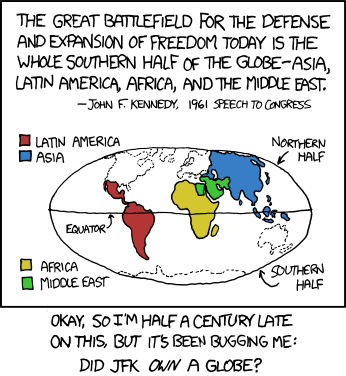 http://xkcd.com/753/
{Not that the non-JFKs among us are immune from this sort of thing. In the US alone:
+Large portions of West Virginia are actually east of much of Virginia, and some parts of Virginia are west-er than any part of "West" Virginia.
+Spartanburg, South Carolina is north of Wilmington, NORTH Carolina.
+The East River flows south as it makes its way through New York City, and the easternmost point in the continental US is called, what else, West Quoddy Head.
+South Bend is in extreme northern Indiana, West Bend a long way from anything we might call "western" Wisconsin, and for the fun of it I'll throw in the fact that Jo Daviess County in the northwestern corner of Illinois is traditionally lumped in with Carbondale, Decatur, and Cairo as part of the region known as "Downstate."
Okay, okay, I know there are reasons for all these names, North Carolina is (mostly) north of South Carolina, the East River is east (of Manhattan), Downstate Illinois basically means not-Chicago, yeah, yeah, yeah, what-ever. I still say we need truth in advertising. What's west should never be east, and what's down should not be up, and it should be possible to distinguish north from south easily and quickly and confidently. The spatial reasoning skills of our youngsters are at stake! Won't someone please think of the children?}
Subscribe to:
Posts (Atom)
